
Editor's Note
The Brookover Review publishes perspectives from experienced federal financial management practitioners. Contributor articles are reviewed for editorial clarity, consistency, and alignment with the publication's standards while preserving each author's professional perspective. The views expressed are those of the author and are intended to encourage thoughtful discussion and advance the practice of federal financial management.
Accuracy consists of two elements.
Most organizations set up controls for one of them and consider that sufficient.
It isn't a lesser control. It's simply an incomplete one.
If your accuracy controls stop at "Is this number right?", they may be doing only half the job the Green Book actually asks for.
Why It Matters
The U.S. Government Accountability Office's Standards for Internal Control in the Federal Government defines the accuracy information-processing objective in Principle 10, §10.18:
Data relating to transactions and events are properly and timely recorded.
Read that definition again.
It has two parts:
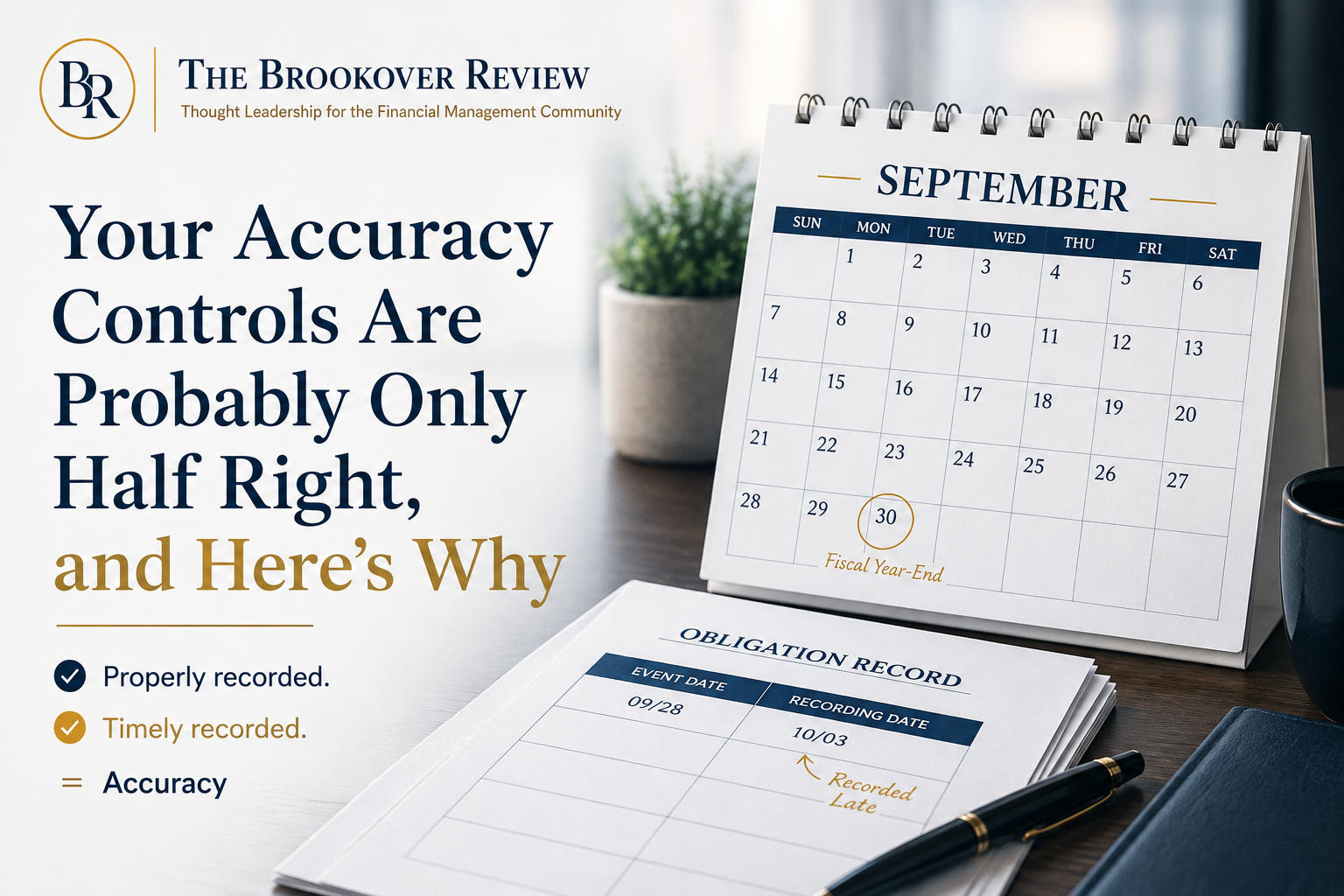
Properly recorded. Timely recorded.
Those are separate ideas.
Many organizations build controls around the first half and stop. Edit checks, field validations, three-way matches, and recalculations can all help confirm that the data associated with a transaction is correct.
What's harder — and often less visible — is confirming that the transaction or event was recorded in the period in which it actually belongs.
That gap isn't always obvious during daily operations. It tends to surface around period-end or year-end, when an event occurring in one reporting period isn't recognized until the next.
That's when the auditor starts asking a different question:
The transaction may be correct, but was it recorded at the right time?
"Properly" and "Timely" Are Two Different Tests
A three-way match confirms that the purchase order, receiving report, and invoice agree. An edit check confirms that a field is populated with a value in the correct format. A recalculation confirms that the math works.
All of that is legitimate accuracy work.
But none of it necessarily tells you whether the transaction was recognized in the period associated with the underlying event.
You can build an airtight validation control and still have a timeliness problem.
Timeliness is about the transaction's relationship to a reporting period. A system can reject a transaction with a missing required field in real time. It's much harder for that same system to determine that an event occurred on September 28 and should have been recognized before the September 30 fiscal year-end rather than appearing for the first time in October.
That's why timeliness is harder to control.
It's not that agencies don't care about period cutoff. It's that many of the controls available for "properly recorded" are relatively straightforward to automate, while the controls needed for "timely recorded" often require a different type of procedure entirely.
- Cutoff procedures
- Aging analysis
- Receiving activity reviews
- Accrual procedures
- Subsequent-event analysis
- Targeted manual review around period-end
The controls needed to determine whether something was properly recorded aren't necessarily the controls needed to determine whether it was timely recorded.
Timeliness Failures Don't Always Look Like Errors
A transaction recorded in the wrong period may have the correct vendor, the correct amount, the correct account, the proper authorization, and valid supporting documentation.
By every other test, it can look perfectly fine.
That's what makes a timeliness failure difficult to identify. Nothing about the transaction itself necessarily signals a problem.
The problem becomes visible when you compare when the underlying event occurred with when the accounting system recognized it.
And that's a comparison many transaction-level accuracy controls were never designed to make.
The Objection Worth Taking Seriously
A reasonable pushback is: "If the amount, account, and authorization are all correct, does it really matter which period it lands in? The lifetime total is still right."
It matters.
Federal financial statements and budgetary reports are period-specific by design. An accrual recorded in the wrong period can misstate that period's expenses and liabilities even if the accounting eventually corrects itself in the following period. Improper cutoff in budgetary activity can similarly distort the reported status of budgetary resources at period-end.
The lifetime total being correct doesn't rescue the reporting period.
Point-in-time reporting doesn't average activity across periods. It answers a specific question:
What was financially true as of this date?
A timeliness failure can make that answer wrong even when everything else about the transaction is right.
Join the Practitioners Reading Ahead
Independent, practitioner-written analysis on federal finance, systems, and audit readiness — delivered before it hits your feed.
A Simple Example
Suppose an agency has an existing obligation for goods that have not yet been delivered. As September 30 approaches, the accounting records appropriately reflect the amount as an undelivered order.
Then the goods arrive on September 28.
The underlying business event has now changed. The goods are no longer undelivered.
But assume the receiving activity isn't processed through the financial system until October 3.
When it is eventually processed, everything about the transaction may be correct. The receiving report is accurate. The invoice agrees with the purchase order. The vendor is correct. The amount is correct. The accounting classification is correct. The transaction is properly authorized.
Run the traditional transaction-level accuracy tests and everything may pass.
But now look at the agency's financial position as of September 30.
The financial system may still show an undelivered order for goods that had already been delivered. The associated delivered-order status, liability, and applicable expense or asset recognition may not be reflected until the following fiscal year.
The problem isn't that the transaction itself was wrong.
The problem is when the accounting says the event happened.
Every control designed solely to determine whether the transaction was properly recorded can pass while the agency still fails the timely recorded component of accuracy. And none of those controls will catch the problem if none of them is checking the calendar.
This Is a Cutoff Problem — and a Control Design Problem
Organizations frequently treat cutoff as a period-end or year-end close problem.
It is.
But it's also an accuracy-control problem.
If the accuracy objective requires transactions and events to be properly and timely recorded, then a control environment heavily weighted toward validating transaction attributes may address only part of that objective.
That doesn't mean every transaction needs another manual review. It means the control design should recognize that the two components of accuracy may require different evidence.
Evidence for "Properly Recorded"
- Edit checks
- Field validations
- Recalculations
- Three-way matches
- Account validations
Evidence for "Timely Recorded"
- Period-end cutoff testing
- Receiving activity around reporting dates
- Subsequent invoice analysis
- Accrual reviews
- Aging reports
- Exception analysis
Same accuracy objective. Different risks. Different evidence. Different controls.
When Timeliness Becomes a Funds-Control Issue
Most timeliness failures begin as accounting or reporting problems. But timing can become more consequential when the transaction crosses a boundary in the legal availability of budgetary resources.
Consider an obligation that should have been recorded while an appropriation was available for new obligations but isn't recorded until after its period of availability has ended.
The vendor may be correct. The amount may be correct. The accounting classification may be correct.
But now there is a much more important question:
When was the obligation actually incurred?
If the agency validly incurred the obligation while the appropriation was available but failed to record it until later, the accounting records need to reflect the substance and timing of that prior-year event.
If, however, the obligation was actually incurred only after the appropriation's period of availability ended, the agency cannot make expired authority available for a new obligation simply by assigning the transaction to the earlier period.
The date is no longer just a financial-reporting issue. It helps determine which budget authority was legally available when the obligation was incurred.
Cancellation Creates Another Boundary
The same concept applies at the other end of an appropriation's lifecycle.
Suppose an agency has a valid obligation, but the related payment isn't processed until after the appropriation originally charged has canceled.
The underlying obligation doesn't necessarily disappear because the account canceled. But the accounting and funding mechanics change.
The agency cannot simply process a payment against a canceled appropriation as though the account remained available indefinitely. At that point, the agency must determine the proper statutory and accounting treatment for liquidating a valid obligation associated with a canceled account, including whether a currently available appropriation must be used under the applicable canceled-account rules.
Again, the amount can be correct. The vendor can be correct. The underlying liability can be valid.
But when the payment occurs matters.
Apportionment Creates a Third Timing Boundary
Now consider the beginning of a new fiscal period. An agency has received new budget authority, but the applicable resources have not yet been apportioned for obligation.
A transaction can contain perfectly accurate data and still raise a serious funds-control issue if the underlying obligation is incurred before the agency has the necessary apportionment.
Here the calendar isn't merely determining which reporting period contains the transaction. It's helping determine whether the agency had the legal authority to incur the obligation at that point in time.
That's where the distinction between a late accounting entry and the timing of the underlying event becomes especially important.
An obligation validly incurred in an earlier period but recorded late presents one accounting problem. An obligation actually incurred in a new period before the applicable resources are legally available for obligation presents a very different funds-control problem.
Depending on the circumstances, the latter can implicate statutory funds-control requirements, including the Antideficiency Act.
The Date Can Change the Analysis
These examples all point to the same principle.
A timeliness problem can affect more than whether a transaction appears in September or October. The relevant questions may become:
- When did the underlying obligation or event actually occur?
- Was the appropriation available for that purpose at that time?
- Had the applicable budgetary resources been apportioned?
- Had the appropriation expired or canceled before the subsequent accounting event occurred?
- What authority was legally available when the agency acted?
Those questions can determine the proper accounting treatment, the appropriation that may be charged, the agency's reported financial position, and potentially its compliance with statutory funds-control requirements.
That is why timeliness deserves to be treated as more than an administrative processing metric.
The date isn't just an accounting attribute. In federal financial management, it can determine what authority was legally available when the transaction occurred.
The Ask
Accuracy controls should answer two separate questions, not one.
Not just: "Is this transaction's data correct?"
But also: "Was this transaction or event recorded in the period in which it belongs?"
Take an hour this month and pull your list of accuracy controls. For each one, ask which part of the definition it actually tests. Properly? Timely? Both?
If every control on the list tests "properly" and none tests "timely," you may have a gap that remains invisible during normal operations and surfaces only during the next cutoff review.
And by then, what could have been a control improvement may already be an audit finding.
Accuracy is one of three information-processing objectives in the GAO Green Book. Get the full picture in the rest of the series: Completeness and Validity.
The views expressed in this article are those of the author and do not necessarily reflect the views of any employer, client, agency, or organization. Examples referenced are intended to illustrate broader internal control design concepts.
About The Brookover Review
The Brookover Review is an independent publication dedicated to advancing federal financial management through practical insights, original frameworks, and thoughtful discussion. Subscribe to receive monthly bulletins, future articles, and original frameworks covering federal financial management, financial systems, audit readiness, and digital transformation.