Editor's Note
The Brookover Review publishes perspectives from experienced federal financial management practitioners. Contributor articles are reviewed for editorial clarity, consistency, and alignment with the publication's standards while preserving each author's professional perspective. The views expressed are those of the author and are intended to encourage thoughtful discussion and advance the practice of federal financial management.
Ask ten people in federal finance what "audit readiness" means, and you will get ten different answers. That fragmentation is not just an inconvenience. It is the problem.
Without a shared definition of what readiness actually is, agencies end up chasing the wrong thing — and they only find out at the worst possible moment.
What Audit Readiness Actually Means
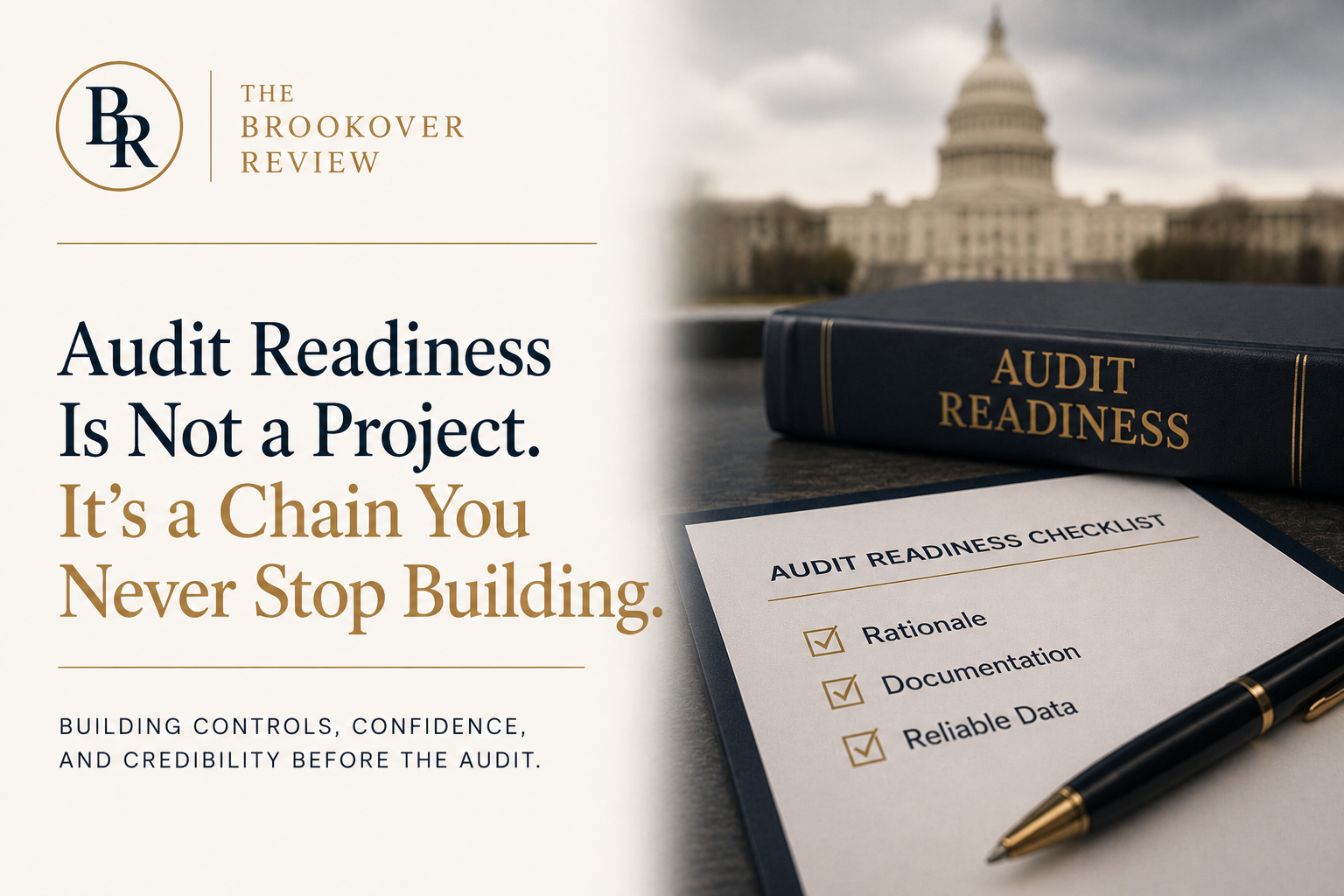
Federal audit readiness is a defensible chain of three continuously maintained elements.
Element 1
Rationale
The why behind every decision. Not just what you did, but why you chose that approach instead of another.
Element 2
Documentation
Evidence that you did what you said you would do. Signatures, dates, approvals, system logs, and review notes — all of it.
Element 3
Reliable Data
Inputs that were complete, accurate, and relevant. If a control depends on a report, know where the data came from and how to verify it.
All three, connected. All three maintained continuously. Audit readiness is not a status you achieve. It is not a certification you earn. It is a chain you build and never stop maintaining.
Why Many Federal Agencies Treat Readiness as a Year-End Sprint
Many agencies treat audit readiness as a year-end sprint — something you push toward in July and August, cross the finish line in September, and deprioritize in Q1. The reason is predictable: in October, audit season for the new fiscal year feels far away — the prior year audit is still ongoing. There are loose ends from the prior fiscal year that just closed still requiring attention, and the new fiscal year is already generating its own competing priorities. Caught between the two, readiness gaps get noticed and noted — but the response is almost always the same: we will fix it later.
Later becomes July. And by July, there is not enough time to fix anything properly. There is only enough time to scramble. This framing is the problem. It assumes readiness is a state you reach and hold. It is not. Once you stop maintaining the chain, it breaks — and the break usually happens quietly, months before anyone notices.
How a Readiness Chain Breaks Quietly
Picture an agency that stood up a new financial system three years ago. They had consultants. They had implementation documentation from the vendor. In year one, everything worked. They may have even had a clean audit opinion.
Then the system matured. Operations changed. New reports were created. Existing reports were tweaked. Staff turned over. And the documentation? Still the vendor version. Never tailored to how the agency actually uses the system. Reports are run every month, but no one has documented which parameters were selected or why. Procedures explain what to do without explaining why. When something changes, staff cannot figure out what to update, because they never understood why the original was the way it was.
The audit readiness chain has broken. Rationale is gone. Documentation exists but does not tie back to anything. Data reliability cannot be defended because no one can prove the reports are still pulled from the right tables. On paper, the agency looks ready. Then the auditor asks a follow-up question, and the whole thing unravels.
What Sustained Audit Readiness Looks Like in Practice
Now picture a different agency. Their documentation is heavier, and that is by design. Procedures explain the mechanical steps and the underlying policy driving them. Reports used in controls come with parameter guidance: what to select, why to select it, and what result you should expect. Staff know which system tables the reports pull from, so they can validate that the information used in controls is complete and accurate.
When operations change, this agency notices. When the system gets updated, they trace what it affects. When a report starts producing different results, they know how to investigate because they know how the report was built. Staff do not execute procedures because the SOP says so. They understand the reasoning, so they respond intelligently when circumstances shift.
The chain holds. Rationale is documented. Documentation produces defensible evidence as a byproduct of the work. Data reliability can be traced back to the source. Nothing about this agency's audit posture depends on a July sprint, because audit readiness never went away.
Turning the Audit From an Ambush Into a Showcase
When you operate this way, the audit stops being adversarial. It is not a test. It becomes a chance to show your work: here is the rationale for what we did, here is the evidence we did it, and here is why the data we used was reliable and relevant. The auditor is not there to catch you. The auditor is there to look at a chain you have already built.
Agencies that treat audit readiness as a defensible chain spend the audit walking the auditor through decisions they can defend. The audit result stops being uncertain. It becomes a reflection of how the agency was operating all along.
Join the Practitioners Reading Ahead
Independent, practitioner-written analysis on federal finance, systems, and audit readiness — delivered before it hits your feed.
The place to start is simpler than most expect: pull one procedure and ask whether it explains the why, not just the how. The answer will tell you where your chain stands.
The views expressed in this article are those of the author and do not necessarily reflect the views of any employer, client, agency, or organization. Examples referenced are intended to illustrate broader audit readiness concepts and practices.
About The Brookover Review
The Brookover Review is an independent publication dedicated to advancing federal financial management through practical insights, original frameworks, and thoughtful discussion. Subscribe to receive monthly bulletins, future articles, and original frameworks covering federal financial management, financial systems, audit readiness, and digital transformation.