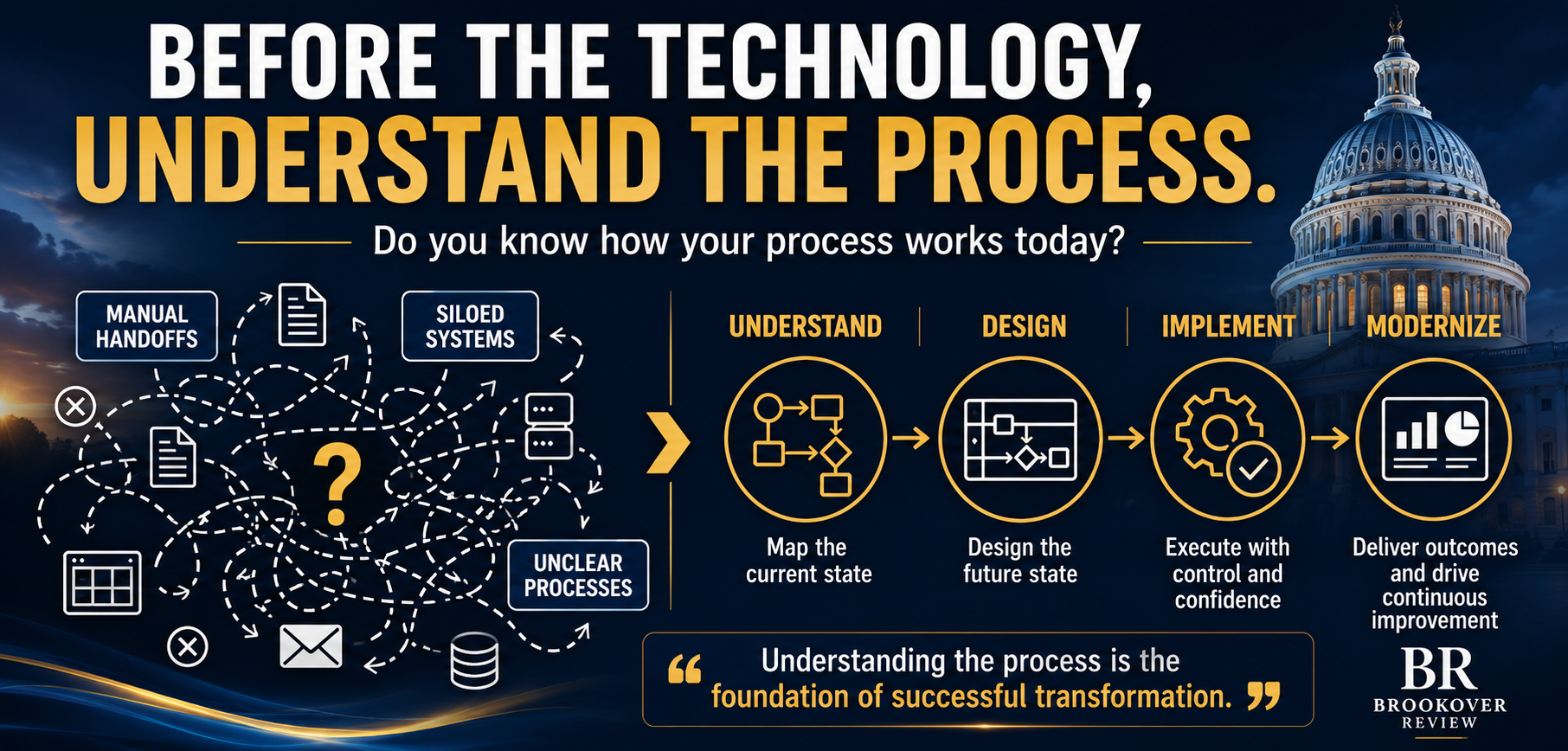
Many organizations spend months selecting software before they can clearly explain how the business process they intend to transform actually works.
Organizations across the public and private sectors routinely commit millions — and in some cases hundreds of millions of dollars — to digital transformation initiatives, enterprise software implementations, artificial intelligence solutions, and modernization programs.
The pattern is often familiar.
A business problem is identified.
Funding is secured.
A modernization initiative is announced.
Procurement planning begins.
Vendors are evaluated.
Software demonstrations are conducted.
Implementation partners are considered.
Then, after contracts are awarded and projects begin, organizations start asking a fundamental question:
How does the business actually work?
Join the Practitioners Reading Ahead
Independent, practitioner-written analysis on federal finance, systems, and audit readiness — delivered before it hits your feed.
By that point, they may already be months into a procurement effort and millions of dollars into a transformation initiative.
This raises an important question:
Why are organizations willing to purchase technology before they fully understand the business processes the technology is intended to support?
Why Process Discovery Belongs in the Business Case
In many organizations, process discovery is treated as an implementation activity.
The common assumption is that once a system integrator or consulting partner is engaged, detailed process analysis and process mapping will occur as part of the project.
While this approach is common, it can introduce significant risk.
There is a strong argument that process discovery should occur much earlier and serve as a foundational input into the business case itself.
Organizations routinely develop business cases to justify transformation initiatives. They estimate costs, identify expected benefits, evaluate alternatives, develop acquisition strategies, and secure funding.
Yet one of the most important inputs is often missing: a documented understanding of how the business operates today.
Before purchasing software licenses, issuing a solicitation, evaluating vendors, or awarding implementation contracts, leadership should be able to clearly explain how work flows through the organization.
Current-state process discovery is not simply an exercise in documentation. It is an opportunity to identify inefficiencies, expose operational risks, uncover process variations, understand data dependencies, and establish a foundation for future-state design.
The Most Expensive Process Mapping Exercise
One of the most expensive process mapping exercises an organization can undertake is the one performed after contract award.
When process discovery occurs during implementation, every new finding carries a cost.
- Unknown business rules become change requests.
- Undocumented workflows become design sessions.
- Process variations become scope increases.
- Operational dependencies become schedule delays.
As implementation teams uncover realities that were not identified during planning, requirements expand, budgets grow, and timelines shift.
These challenges are frequently described as technology failures.
More often, they are business understanding failures.
The software did not create the problem.
The software exposed a problem that already existed.
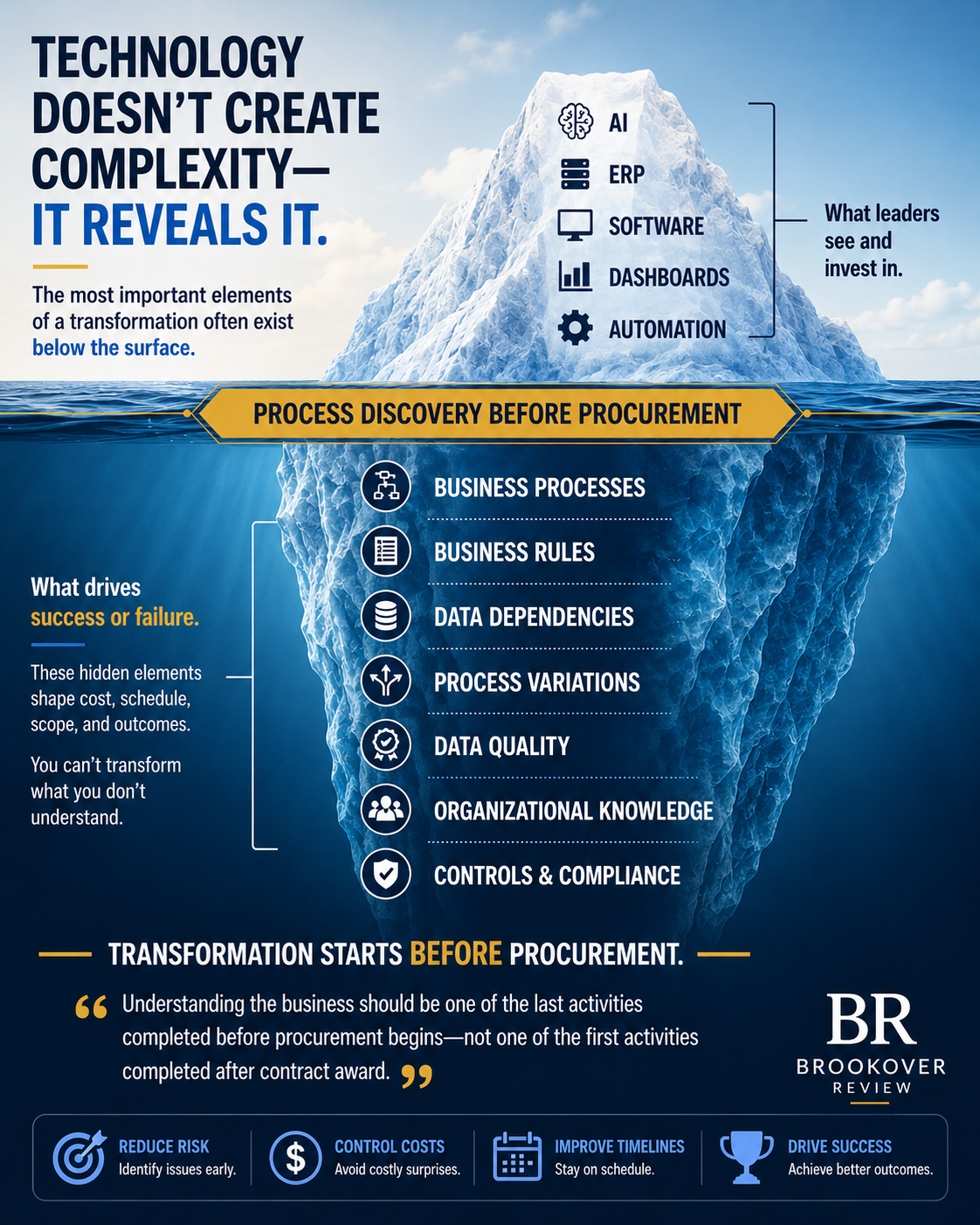
Understanding the business should be one of the last activities completed before procurement begins — not one of the first activities completed after contract award.
Technology Doesn't Create Complexity — It Reveals It
Consider a common modernization effort.
An organization decides to replace a financial management system, ERP, budget formulation platform, grants management solution, or enterprise performance management tool.
Funding is approved. Technology is selected. Implementation begins.
Then process discovery workshops start.
The project team discovers process variations across organizations, undocumented business rules, inconsistent data definitions, and manual workarounds that have evolved over years to compensate for system limitations.
As these discoveries emerge, project scope expands. Additional integrations become necessary. Design assumptions change. Schedules shift. Budgets grow. Stakeholders become frustrated.
The technology did not create these issues.
The implementation effort simply exposed operational realities that were not fully understood before procurement began.
Organizations that understand their current-state operations before selecting technology are significantly better positioned to manage transformation risk than those attempting to discover their business processes during implementation.
Why Artificial Intelligence Raises the Stakes
Artificial intelligence has become a central component of many modernization strategies.
However, artificial intelligence is not a substitute for process maturity.
In many cases, it requires greater process maturity.
Artificial intelligence relies on data. Data is generated through business processes. If business processes are inconsistent, poorly documented, or executed differently across organizations, the data produced by those processes will reflect those inconsistencies.
Organizations may find themselves applying advanced technology to operational environments that are not producing consistent inputs.
And inconsistent inputs rarely produce reliable outcomes.
Before organizations ask whether artificial intelligence can improve a process, they should first ask whether the process itself is sufficiently understood, documented, and consistently executed.
The success of an AI initiative may depend less on the sophistication of the model and more on the maturity of the business processes that support it.
Federal Regulatory Requirements Belong in Process Discovery
Federal transformation initiatives operate in an environment that the private sector rarely encounters.
Current-state process discovery in the federal space should include more than business workflows and operational dependencies. It should also document the regulatory requirements that govern how those processes must be performed.
Guidance from the Department of the Treasury, the Office of Management and Budget, the Government Accountability Office, and the Federal Accounting Standards Advisory Board shapes how federal financial processes are designed, executed, and reported. These requirements are not static. New circulars, revised standards, updated reporting requirements, and audit findings can change the design assumptions a project team built its solution around — sometimes while an implementation is actively underway.
When regulatory requirements are documented as part of process discovery, organizations establish a clear baseline. If guidance changes mid-implementation, the impact can be assessed against something concrete. Teams can identify which processes are affected, which design decisions need to be revisited, and what the downstream consequences are — before those consequences show up as scope changes or audit findings.
Organizations that treat regulatory compliance as a fixed assumption at project inception, rather than a documented input to process discovery, may find themselves redesigning solutions that were accurate when scoped but no longer aligned by the time they are deployed.
In the federal space, understanding the business means understanding the regulatory environment it operates in.
Consultants Cannot Replace Organizational Knowledge
Understanding the business before procurement does more than reduce project risk. It improves communication between business and technical stakeholders throughout the implementation lifecycle.
Consultants and system integrators provide tremendous value. Many have implemented similar processes across dozens of organizations and possess deep knowledge of industry-leading practices, operating models, regulatory requirements, and technology capabilities.
However, consultants and clients bring different forms of expertise.
- Consultants understand the process domain.
- Organizations understand their implementation of that process.
Every organization contains unique policy interpretations, approval chains, data dependencies, reporting requirements, system integrations, and operational workarounds that have evolved over time.
Even the most experienced consultant cannot design an effective future-state solution without understanding those realities.
When organizations assume consultants will discover and document their operational environment after project kickoff, project risk increases substantially.
Successful transformations combine organizational knowledge with external expertise long before technology selection and implementation begin.
When current-state processes are well documented before the engagement begins, business SMEs can walk implementation partners through the operation clearly and confidently. Discovery workshops move faster. The development team receives requirements grounded in real operational context rather than assumptions. And scope is defined before it becomes a negotiation.
The result is less time spent uncovering the business — and more time spent improving it.
Process Before Platform
Before selecting technology, organizations should be able to answer several fundamental questions:
- How does work flow through the organization today?
- Where are the bottlenecks?
- What process variations exist across the enterprise?
- Which workarounds exist because current systems are inadequate?
- What business rules drive operational decisions?
- What does success look like in a future-state environment?
Only after these questions are answered should technology selection begin.
The sequence should be straightforward:
- Understand the business.
- Document the process.
- Identify inefficiencies and risks.
- Define the future state.
- Evaluate technology solutions.
- Procure the solution.
- Execute the transformation.
Technology remains an essential enabler.
But transformation does not begin with software.
It begins with understanding.
Final Thoughts
Transformation initiatives are often viewed as technology projects.
In reality, they are business understanding projects enabled by technology.
The organizations that achieve the greatest success are not necessarily those that select the most advanced platform, hire the largest consulting team, or invest the most money.
They are the organizations that possess a clear understanding of how work is performed before transformation begins.
That understanding should inform the business case. It should shape requirements. It should guide technology selection. And it should provide the foundation for future-state design.
Recent examples from the private sector reinforce the importance of aligning technology investments with operational realities. In 2026, Starbucks discontinued an AI-powered inventory initiative after operational challenges emerged during implementation. While public reporting does not suggest a single cause, the situation illustrates an important reality for transformation leaders: technology success depends on more than technology itself. It depends on the business processes, operational controls, data quality, and organizational readiness that support it. Understanding those elements before making significant technology investments can reduce risk, improve implementation outcomes, and increase the likelihood of long-term success.
Government organizations operate under a different model.
Federal, state, and local agencies are entrusted with taxpayer resources. Unlike shareholders, taxpayers do not choose whether to invest in a particular modernization initiative. Public officials therefore carry an even greater responsibility to ensure that technology investments are supported by a clear understanding of business processes, operational requirements, and mission needs before significant funds are committed.
Before investing millions of dollars in software licenses, issuing a solicitation, awarding an implementation contract, or launching a transformation initiative, leaders should ask a simple question:
Do we understand our business processes well enough to transform them?
If the answer is no, the organization may not be ready to begin procurement.
Because understanding the business should be one of the last activities completed before procurement begins — not one of the first activities completed after contract award.
Transformation starts before procurement.
References
Cunningham, Waylon. "Starbucks scraps AI inventory tool across North America." Reuters, May 21, 2026.
https://www.reuters.com/business/starbucks-scraps-ai-inventory-tool-across-north-america-2026-05-21/
The views expressed in this article are those of the author and do not necessarily reflect the views of any employer, client, agency, or organization. Examples referenced are intended to illustrate broader transformation concepts and lessons learned.
About The Brookover Review
The Brookover Review is an independent publication dedicated to advancing federal financial management through practical insights, original frameworks, and thoughtful discussion. Subscribe to receive monthly bulletins, future articles, and original frameworks covering federal financial management, financial systems, audit readiness, and digital transformation.