Every data quality initiative starts with the same diagnosis: the data is bad. Fix the data, fix the problem.
That framing is almost always wrong.
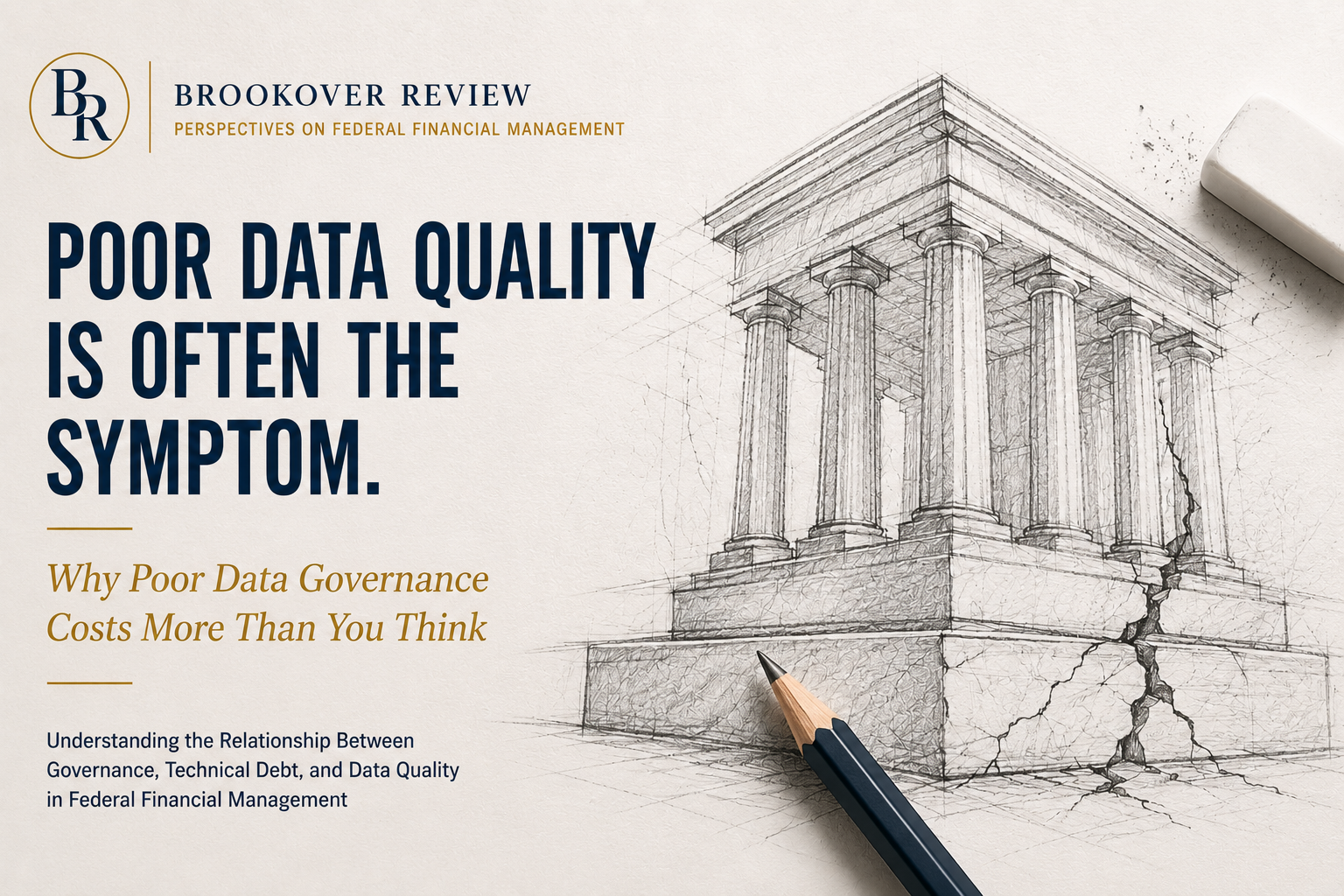
In federal financial management, poor data quality is rarely where the problem begins. It is where years of governance decisions, system limitations, and deferred choices finally run out of places to hide.
What Is Data Governance?
Data governance is one of those terms that gets used frequently and defined inconsistently.
At its core, data governance establishes how data is defined, owned, managed, and trusted across an organization. It is not a technology. It is not a software implementation. It is a set of decisions — about accountability, definitions, and authority — that determine whether financial information can be relied upon.
Effective governance answers fundamental questions:
- What does this data element actually represent, and is that definition shared across systems?
- Who owns this data, and who has authority to change it?
- Which system is authoritative when two systems show different balances?
- Can the number on this report be traced back to a transaction in the system of record?
That last question — traceability — is where governance and audit readiness converge. An auditor asking for support of a balance is not just asking for a number. They are asking for a chain of custody. When governance is weak, that chain has gaps.
Why It Matters in Federal Financial Management
Federal financial management has always been a data business.
Every GTAS submission, every GWA reconciliation, every financial statement, every DATA Act report, every SF-133 and audit sample depends on reliable, attributable financial data. The question is not whether data quality matters — it is whether an agency's governance structure ensures it.
The Foundations for Evidence-Based Policymaking Act of 2018 formalized what practitioners already understood: data is a strategic asset requiring defined ownership, documented lineage, and governance accountability. For federal financial management, that means knowing not just what the numbers say, but where they came from and whether they can be defended.
"Why doesn't this reconcile?" and "Which balance is authoritative?" are governance questions before they are accounting questions.
Join the Practitioners Reading Ahead
Independent, practitioner-written analysis on federal finance, systems, and audit readiness — delivered before it hits your feed.
When those questions surface during a GTAS close or a year-end audit, it is rarely because a transaction was coded incorrectly that week. It is usually because no one ever established a clear answer for the system, and the gap has been papered over with manual adjustments ever since.
From Governance to Technical Debt
Most agencies do not intentionally create technical debt. It accumulates through decisions that were individually reasonable but collectively costly.
A spreadsheet is built to bridge a gap between the procurement system and the core financial system.
A custom interface is written because the standard extract does not capture an agency-specific transaction type.
A manual journal entry is posted each quarter to force a reconciliation to balance.
A reporting adjustment that was supposed to be temporary becomes a standing procedure.
Each of these decisions solved a real problem at the time. Taken together, they create a financial environment where the system of record and the reported numbers are no longer the same thing — and where the difference is maintained through human effort rather than system integrity.
That is technical debt.
Unlike project debt, it compounds quietly until the cost of maintaining the workaround exceeds the cost of correcting the underlying architecture.
When Technical Debt Becomes Data Quality
As technical debt accumulates, the symptoms become familiar to anyone who has worked a federal financial close:
- Two reports pulling from the same system show different balances
- Obligation data in the financial system does not match what the program office is tracking
- The trial balance ties, but only after manual adjustments that nobody documented
- Audit support requires reconstruction because the original transaction cannot be traced
- Year-end close takes longer every year because reconciliation complexity keeps growing
At this stage, leadership often concludes that the agency has a data quality problem and invests in data quality tools, additional reconciliation steps, or more detailed reporting controls.
Those interventions help manage the symptoms. They do not address what created them.
Data quality is often a lagging indicator of governance quality.
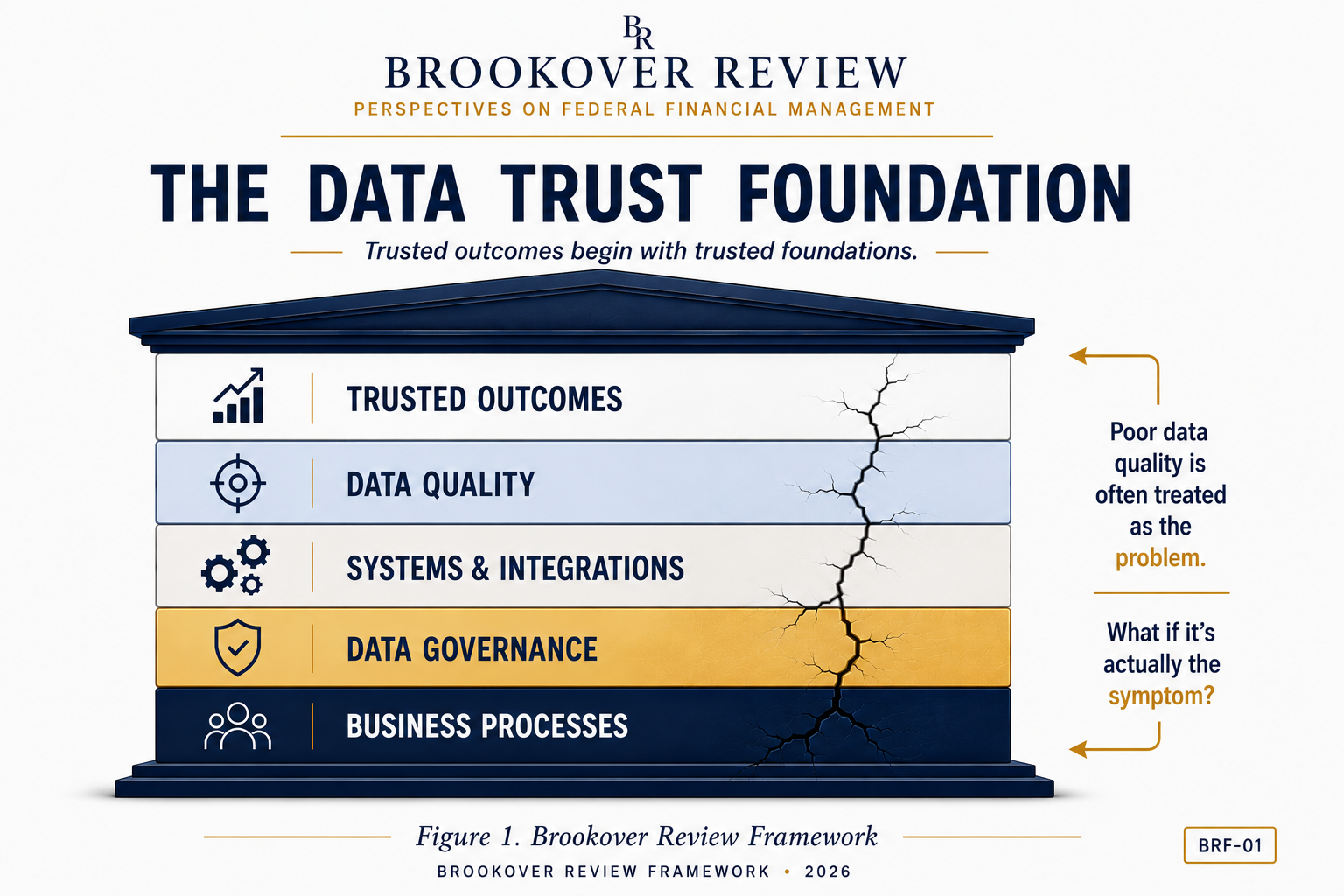
Figure 1 illustrates the relationship between governance decisions, technical debt, and the downstream data quality challenges discussed throughout this article. This framework — BRF-01: The Data Trust Foundation — serves as the conceptual model for the discussion that follows.
Two Financial Realities
One of the more consequential outcomes of accumulated technical debt is the emergence of two separate financial realities operating simultaneously inside the same agency.
The first lives in the core financial system — the system of record that supports GTAS submissions, generates the trial balance, and produces the data auditors will test.
The second lives in everything else: spreadsheet workbooks maintained by the accounting team, consolidation tools that pull and reshape extracts, reconciliation files that exist because the systems never quite agreed, and reporting dashboards built on top of data that has already been adjusted once or twice before it arrives.
This second reality is not fabricated. It usually reflects legitimate reporting requirements — things the core system genuinely could not produce without modification. But over time, the two realities diverge. The adjustments that were once small and well-understood become larger and less documented. The person who built the original reconciliation spreadsheet has left. The logic is still running, but no one can fully explain why.
When an auditor or a new CFO asks which number is right, the honest answer is often: it depends on which version you are looking at, and we are not entirely sure how they relate to each other anymore.
That is not a data quality problem. That is a governance problem that has been growing for years.
Why AI Makes This Harder to Ignore
Artificial intelligence has put data governance back on the agenda for agencies that had set it aside. The reason is practical: AI tools do not normalize inconsistency the way experienced staff do. A seasoned analyst knows which report to trust, which reconciliation step to skip, and which adjustment has been there so long it can be ignored. An AI model does not know any of that. It processes the data it receives at face value.
For agencies with well-governed, traceable financial data, AI represents a genuine accelerant — faster analysis, better anomaly detection, more timely insight for decision-makers.
For agencies with years of accumulated technical debt and undocumented adjustments layered throughout their reporting process, AI does not solve the problem. It surfaces it faster. Inconsistencies that took months to discover through traditional reporting will emerge in the first reporting cycle. The same data quality issues that existed before the AI implementation will still exist after it — they will simply be more visible and harder to explain away.
AI does not fix bad governance. It removes the buffer that allowed agencies to manage around it.
Three Questions Worth Asking Now
An organization does not need a formal data governance program to start closing the gap. It needs honest answers to a few foundational questions:
- Where does a discrepancy go to die? If a balance does not reconcile, is there a defined process for resolving it — or does it get absorbed into a manual adjustment and move on? The answer reveals whether governance accountability actually exists.
- Which system wins? When the core financial system and a downstream reporting tool show different numbers, which one is authoritative and who decides? If there is no clear answer, there is no governance.
- Can you trace the number? Take any significant balance on the financial statements and trace it back to a transaction in the system of record. If that exercise requires more than two or three steps — or if it requires asking someone who holds the knowledge in their head — the traceability gap is already a risk.
Final Thoughts
Poor data quality is rarely created at the moment a report is produced. It is the accumulated result of governance decisions deferred, system limitations accepted, and workarounds that outlasted the problems they were designed to solve.
Federal agencies will continue investing heavily in modernization, analytics, and artificial intelligence in the years ahead. The return on those investments will depend less on the sophistication of the tools chosen and more on the quality of the data those tools are asked to work with.
Governance is rarely the most visible part of a financial systems strategy. It seldom appears in executive briefings, acquisition documents, or modernization roadmaps.
Yet it is the foundation on which every successful modernization effort depends.
The next generation of federal financial systems will not be defined solely by better ERP platforms, analytics, or artificial intelligence. They will be defined by whether agencies invested first in understanding, governing, and trusting the data those technologies depend upon.
Because trusted outcomes do not begin with better tools.
They begin with trusted foundations.
The views expressed in this article are those of the author and do not necessarily reflect the views of any employer, client, agency, or organization. Examples referenced are intended to illustrate broader concepts and lessons learned.
About The Brookover Review
The Brookover Review is an independent publication dedicated to advancing federal financial management through practical insights, original frameworks, and thoughtful discussion. Subscribe to receive monthly bulletins, future articles, and original frameworks covering federal financial management, financial systems, audit readiness, and digital transformation.