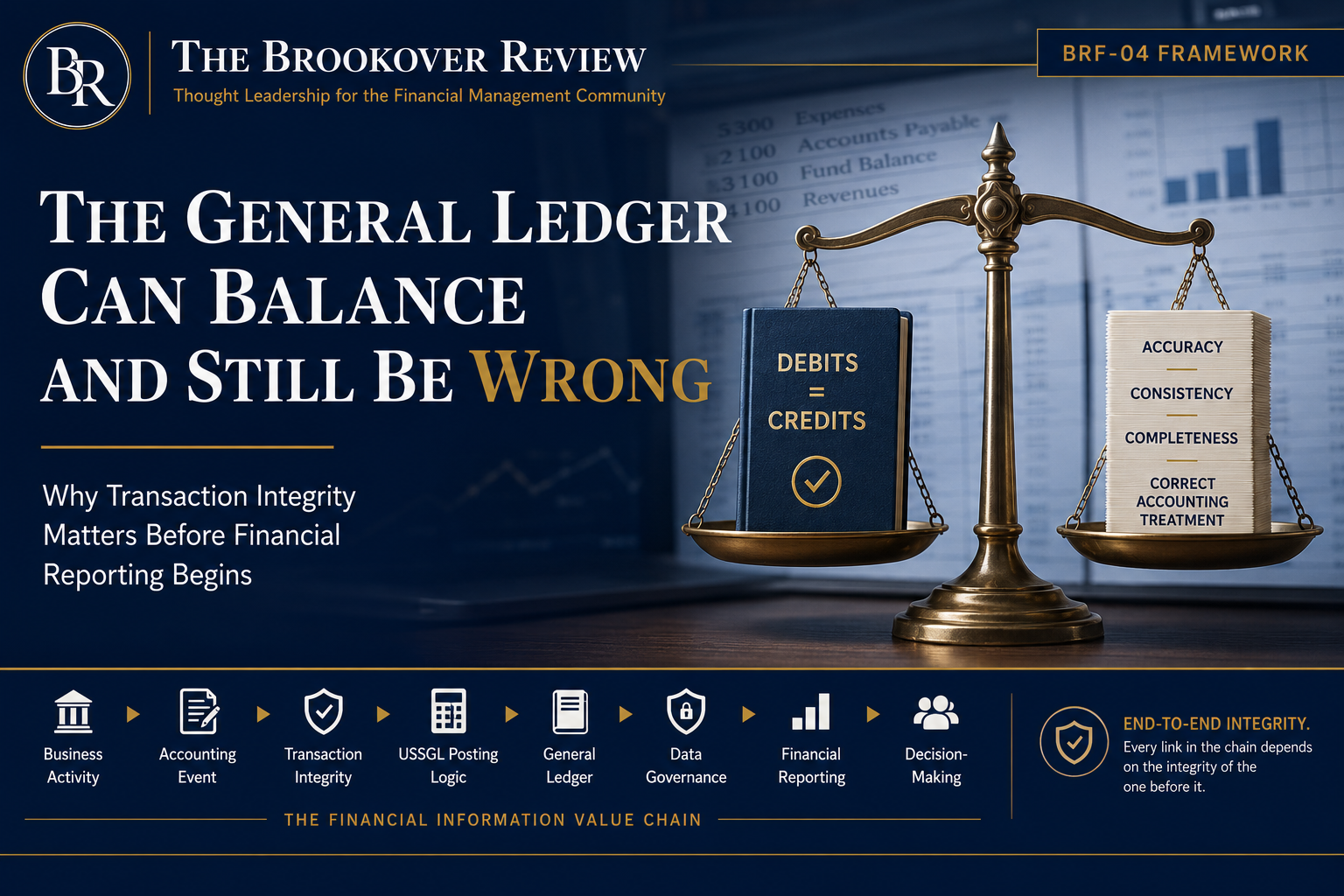
Why Transaction Integrity Matters Before Financial Reporting Begins
A balanced general ledger can provide confidence.
Debits equal credits. Transactions have processed. Reports have been produced. Reconciliations have been completed.
But balance alone does not prove that the underlying financial activity was accounted for correctly.
A transaction can process successfully and still represent the wrong accounting treatment. A system can operate exactly as designed while preserving outdated logic. And financial statements can reconcile while requiring significant effort to explain the activity behind them.
That distinction matters because every financial statement is the final chapter of a story that begins long before it is published.
It begins when business activity enters the accounting process.
The question, therefore, is not simply whether the general ledger balances.
The question is whether it tells the right financial story.
Balance Is an Outcome. Integrity Is the Foundation.
Every financial transaction originates from an operational event.
A contract is awarded.
An employee is paid.
An expenditure is made.
A payment is made to a vendor.
An obligation is incurred.
A liability is recognized.
Each activity carries financial consequences that must ultimately be represented within the organization's accounting records.
That transition — from business activity to financial information — is one of the most important points in the financial lifecycle.
Before financial statements are prepared, before Treasury reporting occurs, and before an auditor examines the results, thousands or millions of individual business events have already established the foundation upon which those products depend.
If those events are translated into accounting correctly, the general ledger can preserve an accurate financial story.
If they are not, the general ledger can still balance.
It may simply be balancing the wrong story.
Where the Foundation Begins to Break
In my experience, weaknesses at this level rarely result from one catastrophic failure. More often, structural conditions allow small inconsistencies to become embedded in normal operations.
Materiality can mask cumulative risk. An individual event may appear insignificant when viewed independently, while the same weakness repeated across a population of transactions can become a systemic financial problem.
Automation can replace understanding. Efficient systems and standardized procedures are essential, but they cannot substitute for understanding the accounting fundamentals beneath them. That distinction becomes particularly important when business activity falls outside the expected process.
Legacy environments can preserve legacy thinking. Financial systems and business processes do not automatically evolve alongside changes in accounting standards, reporting requirements, or government-wide guidance. An organization can execute a process exactly as designed while the design itself has become outdated.
Remediation can become an operating model. Internal and external resources can become exceptionally efficient at reconciling, adjusting, and explaining recurring differences without eliminating the conditions that continue to create them.
These issues share a common characteristic:
They can exist even when the books ultimately balance.
Small weaknesses at the transaction level do not necessarily remain small. They compound as financial information moves through the organization.
By the time the issue reaches financial reporting or audit, the organization may be correcting a problem that began much earlier.
A Successfully Processed Transaction Can Still Be Wrong
This distinction becomes particularly important in highly automated financial environments.
One of the clearest examples I have encountered involves adjustments to prior-year activity.
At the individual transaction level, nothing necessarily appears wrong. The transaction processes successfully. The system accepts it. Reporting continues.
Yet when the activity is evaluated collectively, patterns can emerge that indicate the underlying accounting treatment is inconsistent with the financial activity it is intended to represent.
The technology may have performed exactly as designed.
The weakness occurred earlier — in how the business activity was interpreted and translated into accounting.
That leads to an important principle:
A successfully processed transaction is not necessarily a correctly accounted-for transaction.
Technology can determine whether a transaction satisfies programmed rules.
It cannot, by itself, guarantee that those rules represent the appropriate accounting treatment for every underlying business event.
That distinction becomes increasingly important as organizations pursue greater automation.
Join the Practitioners Reading Ahead
Independent, practitioner-written analysis on federal finance, systems, and audit readiness — delivered before it hits your feed.
The General Ledger Records the Story. It Does Not Validate Every Chapter.
Modern ERPs, automation, advanced analytics, and artificial intelligence can dramatically improve the speed and efficiency of financial operations.
But technology cannot create integrity in information that was not captured correctly.
The general ledger ultimately reflects the cumulative results of the financial activity provided to it.
That is why a balanced general ledger should not automatically be equated with a healthy financial environment.
The general ledger does not invent financial truth. It remembers what the organization told it.
A faster system processing weak financial information simply produces weak financial information faster.
Modernization therefore cannot be viewed exclusively as a technology challenge.
The underlying business and accounting foundation still matters.
Preserving the Right Story
In a previous Brookover Review article, I argued that USSGL posting logic is not simply about balancing debits and credits. It exists to preserve the financial story by maintaining relationships as financial activity moves through the accounting lifecycle.
But there is an important prerequisite.
The story being preserved must be right.
If the underlying accounting event does not accurately represent the business activity, downstream accounting logic cannot reconstruct what should have happened simply because the resulting entries balance.
The same principle applies to data governance.
Governance can establish ownership, standards, controls, and accountability around financial information. But governance becomes considerably more difficult when organizations are attempting to repair information after weaknesses have already entered the financial process.
These concepts are connected.
The transaction establishes the story. Accounting records it. USSGL logic preserves it. Data governance protects it. Financial reporting communicates it.
Each depends upon the integrity of what came before.
Transaction Integrity: Looking Beyond Balance
I refer to this concept as Transaction Integrity — the degree to which financial activity accurately and consistently represents the underlying business activity as it moves through the financial lifecycle.
At an executive level, the question is straightforward:
Can the organization trust that the financial activity entering its systems accurately represents what actually occurred?
That is a different question from asking whether the books balance.
When Transaction Integrity is strong, downstream accounting, reporting, reconciliation, and audit become more reliable.
When it is weak, organizations begin compensating.
More reconciliations.
More manual adjustments.
More spreadsheets.
More controls.
More explanations.
Those activities may sometimes be necessary. But recurring remediation should trigger a more important question:
Why are we repeatedly correcting downstream what could have been prevented upstream?
BRF-04 — The Financial Information Value Chain
This relationship is illustrated in BRF-04, The Financial Information Value Chain.
The framework follows financial information from the underlying business activity through accounting, the general ledger, governance, reporting, and ultimately decision-making.
Its central premise is simple:
Every link in the chain depends on the integrity of the one before it.
A balanced general ledger is therefore an important checkpoint within the financial lifecycle — but it is not the beginning of the story, nor is it sufficient on its own to establish the integrity of everything that came before it.
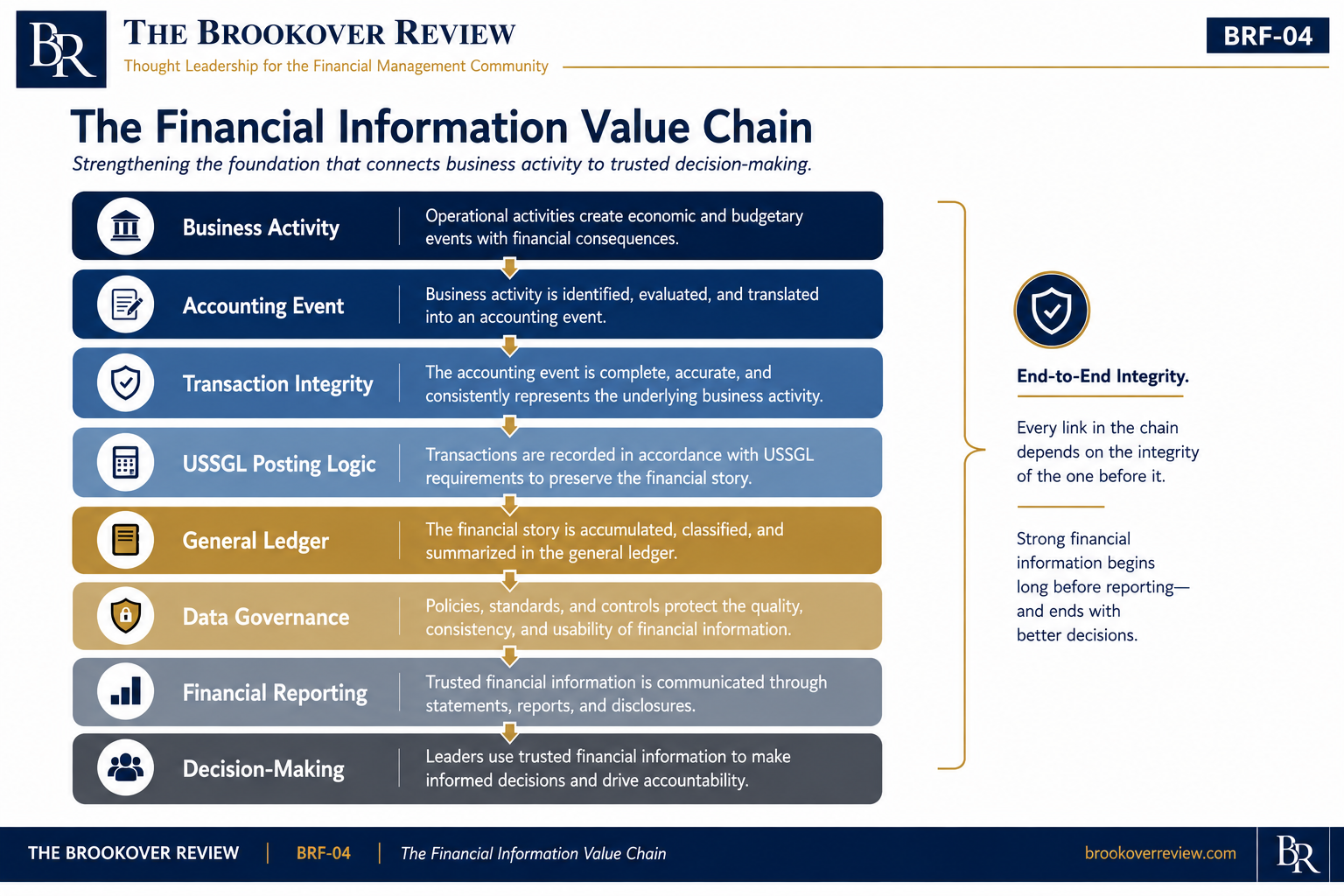
Figure 1. Brookover Review Framework (BRF-04): The Financial Information Value Chain
BRF-04 also highlights an important executive consideration.
Organizations understandably invest significant resources toward the end of the value chain — in reporting, audit readiness, analytics, and modernization.
But improving the final product without strengthening its foundation has limits.
The strongest financial organizations look beneath summarized reporting and ask whether the underlying financial activity remains internally consistent and whether the resulting financial story can be explained.
In the federal environment, that means recognizing that financial accountability ultimately exists at levels deeper than agency-wide totals.
Each Treasury Account Symbol represents a distinct financial environment that should be capable of telling a complete and internally consistent financial story.
The objective is not merely to determine whether balances add up.
It is to determine whether the financial relationships make sense.
How an organization performs that assessment will vary based on its systems, mission, accounting environment, and risk profile.
But the principle remains constant:
A trustworthy financial position should be explainable from the activity that created it.
Stop Treating Balance as the Finish Line
Audit findings rarely begin with the audit.
Reporting problems rarely begin with the financial statements.
Data quality problems rarely begin with the dashboard displaying them.
The visible problem is often the final manifestation of something that occurred much earlier in the Financial Information Value Chain.
This does not mean every downstream issue can be prevented at the transaction level. Financial environments are too complex for such an absolute.
Nor does it diminish the importance of reconciliation and balancing. Both remain fundamental financial controls.
But they should not be mistaken for proof that every underlying transaction was treated correctly.
A mature financial organization should not measure success solely by how efficiently it reconciles differences, processes adjustments, responds to audit requests, closes its books — or simply reaches a balanced position.
It should also ask whether the financial activity behind those balances makes sense.
That represents a fundamental shift in financial management:
From balancing to understanding. From detecting to preventing. From correcting information to protecting its integrity.
Conclusion
A balanced general ledger matters.
But balance is not the same as integrity.
Trustworthy financial reporting is built transaction by transaction throughout the fiscal year.
The strongest financial organizations therefore ask a question that goes beyond whether the general ledger balances:
Does the financial story behind those balances make sense?
Because an organization does not build trust in its financial information simply by getting the numbers to balance.
It builds trust by ensuring those numbers represent what actually happened.
The views expressed in this article are those of the author and do not necessarily reflect the views of any employer, client, agency, or organization. Examples referenced are intended to illustrate broader transaction integrity and financial management concepts.
About The Brookover Review
The Brookover Review is an independent publication dedicated to advancing federal financial management through practical insights, original frameworks, and thoughtful discussion. Subscribe to receive monthly bulletins, future articles, and original frameworks covering federal financial management, financial systems, audit readiness, and digital transformation.