
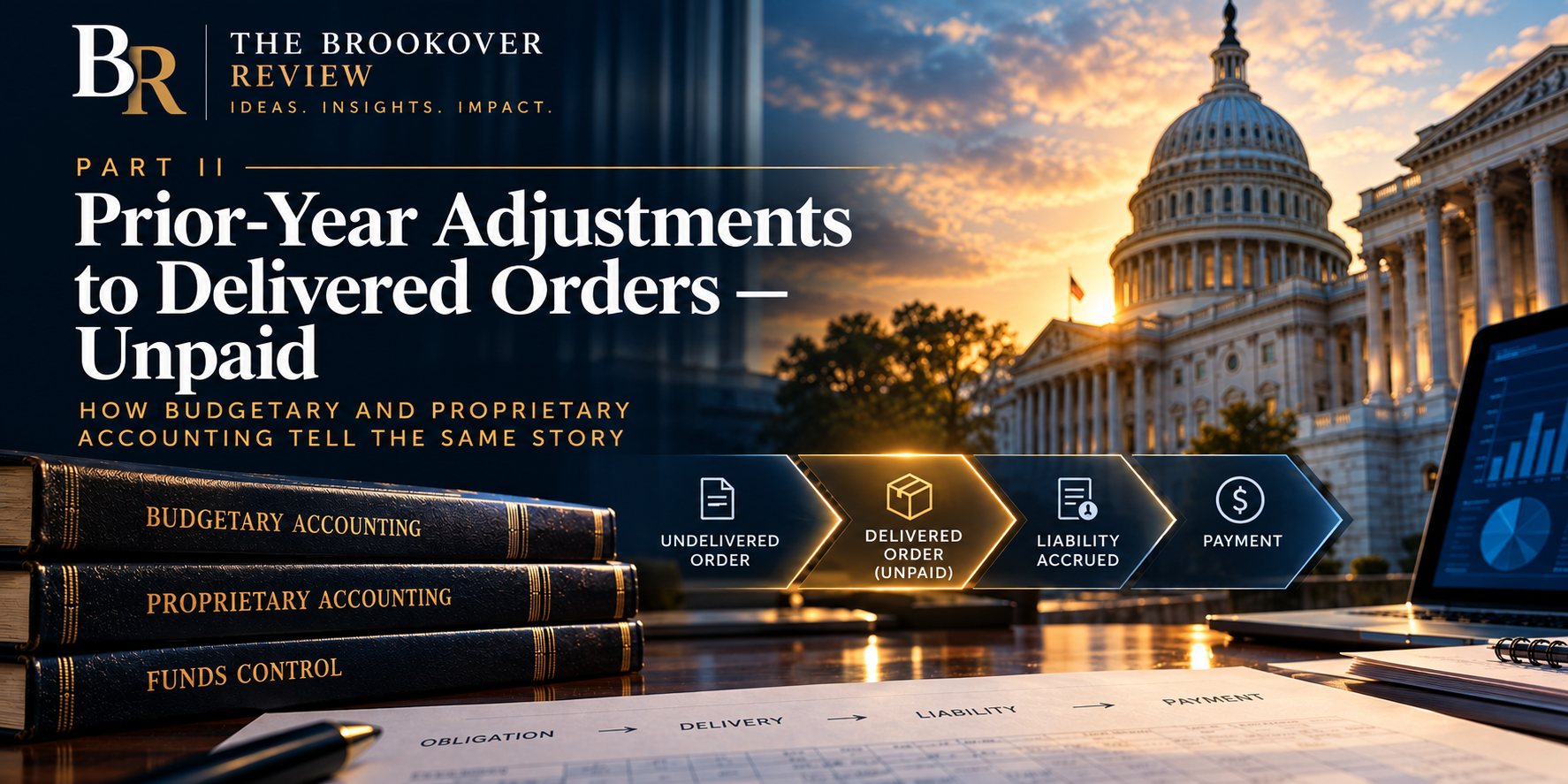
Part II: Prior-Year Adjustments to Delivered Orders — Unpaid
Editor's Note: The prior-year adjustment accounts discussed in this article are used when an obligation recorded in a previous fiscal year is adjusted in a subsequent fiscal year. If the obligation, accrual, or payment is adjusted within the same fiscal year in which it was originally recorded, the original USSGL account is adjusted directly rather than using the separate prior-year upward or downward adjustment accounts.
At some point, an obligation stops being an undelivered order.
The goods arrive. The service is performed. Acceptance occurs. What was once an undelivered obligation becomes a delivered order — but until payment occurs, the government's liability remains.
That transition matters.
Because when the amount changes in a subsequent fiscal year, we are no longer adjusting the same accounting event we examined in Part I.
The obligation may be the same. Its accounting status is not.
A Quick Refresher From Part I
Part I focused on prior-year adjustments to unpaid undelivered orders. Before moving further through the obligation lifecycle, let's briefly revisit those accounts.
| USSGL | Account |
|---|---|
| 480100 | Undelivered Orders — Obligations, Unpaid |
| 487100 | Downward Adjustments of Prior-Year Unpaid Undelivered Orders — Obligations, Recoveries |
| 488100 | Upward Adjustments of Prior-Year Undelivered Orders — Obligations, Unpaid |
The principle was straightforward:
The original obligation and the subsequent adjustment are separate accounting events.
Part II carries that principle forward after delivery.
The goods or services have now been received. A liability has been established. Payment has not yet occurred.
Then something changes.
Accounts Introduced in Part II
| USSGL | Account |
|---|---|
| 490100 | Delivered Orders — Obligations, Unpaid |
| 497100 | Downward Adjustments of Prior-Year Unpaid Delivered Orders — Obligations, Recoveries |
| 498100 | Upward Adjustments of Prior-Year Delivered Orders — Obligations, Unpaid |
| 101000 | Fund Balance With Treasury |
| 183000 | Internal Use Software |
| 211000 | Accounts Payable |
| 310700 | Unexpended Appropriations — Used |
| 310000 | Unexpended Appropriations - Cumulative |
| 331000 | Cumulative Results of Operations |
| 570000 | Expended Appropriations |
| 610000 | Operating Expenses/Program Costs |
The progression from Part I is easy to see:
480100 → 487100 / 488100 becomes 490100 → 497100 / 498100
But delivery introduces another dimension.
With an unpaid undelivered order, our primary focus was the budgetary status of the obligation and the authority supporting it.
Once delivery occurs, the transaction also has a proprietary story.
There may now be a liability. There may be an expense. There may be a capitalized asset. And when the amount of the obligation changes, those proprietary balances may need to change with it.
The budgetary entry is only half the story.
The budgetary and proprietary sides of the general ledger have to tell the same story.
Returning to Our Expired Fund
Let's return to the expired fund used in Part I: Fund 1112222-2525 — Expired.
| USSGL | Account | Beginning | Activity | Ending |
|---|---|---|---|---|
| Budgetary Accounts | ||||
| 420100 | Total Actual Resources — Collected | $1,000 | $0 | $1,000 |
| 465000 | Allotments — Expired Authority | ($500) | $0 | ($500) |
| 480100 | Undelivered Orders — Obligations, Unpaid | ($250) | $0 | ($250) |
| 490100 | Delivered Orders — Obligations, Unpaid | ($250) | $0 | ($250) |
| Budgetary Total | $0 | $0 | $0 | |
| USSGL | Account | Beginning | Activity | Ending |
| Proprietary Accounts | ||||
| 101000 | Fund Balance With Treasury | $1,000 | $0 | $1,000 |
| 211000 | Accounts Payable | ($250) | $0 | ($250) |
| 310000 | Unexpended Appropriations - Cumulative | ($750) | $0 | ($750) |
| Proprietary Total | $0 | $0 | $0 | |
For readability throughout these examples, debit balances are presented as positive amounts and credit balances are presented in parentheses as negative amounts.
The budgetary side shows $1,000 of actual resources: $500 remains as expired allotment authority, $250 remains in an unpaid undelivered order, and $250 has progressed to a delivered order that remains unpaid.
The proprietary side tells us something the budgetary accounts cannot.
The agency has recognized a $250 liability in 211000 — Accounts Payable.
The obligation has moved through its lifecycle, and the proprietary accounting has moved with it.
Where Is the Asset?
There is something intentionally missing from the expired fund's trial balance: the capitalized asset.
For purposes of our example, assume the asset and its related accumulated depreciation were transferred from the expired appropriation to the current unexpired appropriation as part of the agency's year-end accounting process.
We'll revisit the proprietary asset accounting later in the article.
Now the Amount Changes
Assume the $250 in 490100 — Delivered Orders — Obligations, Unpaid relates to services delivered and accepted before year-end.
At close, the agency did not yet know the final amount owed. It accrued $250 based on the best information available.
The new fiscal year therefore begins with $250 in 490100 — Delivered Orders — Obligations, Unpaid and $250 in 211000 — Accounts Payable.
Then better information becomes available.
The estimate changes.
Upward Adjustment: The Estimate Increases
The agency determines that it owes $100 more for the services received.
The original $250 was not necessarily wrong. It represented the agency's best estimate at the time.
But the new information creates a new accounting event.
| USSGL | Account | Debit | Credit |
|---|---|---|---|
| 465000 | Allotments — Expired Authority | $100 | $0 |
| 498100 | Upward Adjustments of Prior-Year Delivered Orders — Obligations, Unpaid | $0 | $100 |
| 211000 | Accounts Payable | $0 | $100 |
| 610000 | Operating Expenses/Program Costs | $100 | $0 |
| 570000 | Expended Appropriations | $0 | $100 |
| 310700 | Unexpended Appropriations — Used | $100 | $0 |
| Total | $200 | $200 | |
Notice what does not happen.
We do not add another $100 to 490100.
The original $250 remains in 490100. The subsequent increase is separately preserved in 498100.
That distinction matters because the ledger now tells us more than the ending amount owed. It tells us how we got there.
On the proprietary side, the same economic event increases 211000 — Accounts Payable by $100 and recognizes the additional program cost. The related financing-source accounts move with that activity.
The liability now stands at $350.
The estimate increased. The obligation increased. The liability increased.
Downward Adjustment: The Estimate Changes Again
Now assume additional information shows that the revised estimate was $50 too high.
Again, we do not rewrite what already happened.
The original $250 remains in 490100. The $100 upward adjustment remains in 498100. The new $50 decrease is recorded as another distinct accounting event.
| USSGL | Account | Debit | Credit |
|---|---|---|---|
| 465000 | Allotments — Expired Authority | $0 | $50 |
| 497100 | Downward Adjustments of Prior-Year Unpaid Delivered Orders — Obligations, Recoveries | $50 | $0 |
| 211000 | Accounts Payable | $50 | $0 |
| 610000 | Operating Expenses/Program Costs | $0 | $50 |
| 570000 | Expended Appropriations | $50 | $0 |
| 310700 | Unexpended Appropriations — Used | $0 | $50 |
| Total | $100 | $100 | |
The liability decreases from $350 to $300.
But the ledger preserves all three events: the original delivered order of $250, the prior-year upward adjustment of $100, and the prior-year downward adjustment of $50.
The ending obligation is $300.
The path to $300 remains visible.
Join the Practitioners Reading Ahead
Independent, practitioner-written analysis on federal finance, systems, and audit readiness — delivered before it hits your feed.
Bringing the Transactions Together
The effect becomes clearer when we look at the activity as a whole.
| USSGL | Account | Beginning | Activity | Ending |
|---|---|---|---|---|
| Budgetary Accounts | ||||
| 420100 | Total Actual Resources — Collected | $1,000 | $0 | $1,000 |
| 465000 | Allotments — Expired Authority | ($500) | $50 | ($450) |
| 480100 | Undelivered Orders — Obligations, Unpaid | ($250) | $0 | ($250) |
| 490100 | Delivered Orders — Obligations, Unpaid | ($250) | $0 | ($250) |
| 497100 | Downward Adjustments of Prior-Year Unpaid Delivered Orders — Obligations, Recoveries | $0 | $50 | $50 |
| 498100 | Upward Adjustments of Prior-Year Delivered Orders — Obligations, Unpaid | $0 | ($100) | ($100) |
| Budgetary Total | $0 | $0 | $0 | |
| USSGL | Account | Beginning | Activity | Ending |
| Proprietary Accounts | ||||
| 101000 | Fund Balance With Treasury | $1,000 | $0 | $1,000 |
| 211000 | Accounts Payable | ($250) | ($50) | ($300) |
| 310700 | Unexpended Appropriations — Used | $0 | $50 | $50 |
| 310000 | Unexpended Appropriations - Cumulative | ($750) | $0 | ($750) |
| 570000 | Expended Appropriations | $0 | ($50) | ($50) |
| 610000 | Operating Expenses/Program Costs | $0 | $50 | $50 |
| Proprietary Total | $0 | $0 | $0 | |
If we looked only at the beginning and ending balances, the activity would appear simple.
Accounts Payable increased from $250 to $300. Expired allotment authority decreased from $500 to $450. Net change: $50.
But that is not what actually happened.
The agency first recorded a $100 upward adjustment and then a $50 downward adjustment.
The ending balance tells you where you are. The adjustment accounts tell you how you got there.
Now Change One Thing: The Authority Is Still Available
So far, our example has involved an expired appropriation.
Now let's change one thing. The authority remains available for obligation. For this example, we'll use Fund 3334444 — 2526/No-Year.
This illustrative fund designation is intended to represent both multi-year and no-year authority that remains available for obligation. Multi-year and no-year appropriations are distinct forms of budget authority; they are combined here solely to demonstrate the accounting treatment applicable to available authority.
We begin with the same basic budgetary position, except 461000 — Allotments — Realized Resources replaces 465000 — Allotments — Expired Authority.
We also reconnect the proprietary asset that was intentionally absent from our expired-fund example.
| USSGL | Account | Beginning | Activity | Ending |
|---|---|---|---|---|
| Budgetary Accounts | ||||
| 420100 | Total Actual Resources — Collected | $1,000 | $0 | $1,000 |
| 461000 | Allotments — Realized Resources | ($500) | $0 | ($500) |
| 480100 | Undelivered Orders — Obligations, Unpaid | ($250) | $0 | ($250) |
| 490100 | Delivered Orders — Obligations, Unpaid | ($250) | $0 | ($250) |
| Budgetary Total | $0 | $0 | $0 | |
| USSGL | Account | Beginning | Activity | Ending |
| Proprietary Accounts | ||||
| 101000 | Fund Balance With Treasury | $1,000 | $0 | $1,000 |
| 183000 | Internal Use Software | $250 | $0 | $250 |
| 211000 | Accounts Payable | ($250) | $0 | ($250) |
| 310000 | Unexpended Appropriations - Cumulative | ($750) | $0 | ($750) |
| 331000 | Cumulative Results of Operations | ($250) | $0 | ($250) |
| Proprietary Total | $0 | $0 | $0 | |
For purposes of this example, assume the agency acquired software licenses that met its capitalization criteria and capitalization threshold. The software is therefore reflected in 183000 — Internal Use Software.
The related $250 delivered-order obligation remains unpaid.
Now the amount changes.
Upward Adjustment: More Software Is Required
Assume the agency determines that it requires an additional $100 of software under the prior-year delivered order.
Because the authority remains available, the budgetary side uses 461000 — Allotments — Realized Resources rather than expired authority.
| USSGL | Account | Debit | Credit |
|---|---|---|---|
| 461000 | Allotments — Realized Resources | $100 | $0 |
| 498100 | Upward Adjustments of Prior-Year Delivered Orders — Obligations, Unpaid | $0 | $100 |
| 211000 | Accounts Payable | $0 | $100 |
| 183000 | Internal Use Software | $100 | $0 |
| 570000 | Expended Appropriations | $0 | $100 |
| 310700 | Unexpended Appropriations — Used | $100 | $0 |
| Total | $200 | $200 | |
The budgetary logic should now be familiar. The original $250 remains in 490100. The $100 increase is separately captured in 498100. The available allotment decreases by $100.
But look at the proprietary side.
In our expired-fund example, the underlying transaction involved services. The increase therefore affected 610000 — Operating Expenses/Program Costs.
Here, the underlying transaction is different.
The additional cost relates to software meeting the agency's capitalization criteria. The $100 increase therefore increases 183000 — Internal Use Software rather than operating expense.
After the adjustment: Internal Use Software moves from $250 to $350. Accounts Payable moves from $250 to $350. Available Allotment moves from $500 to $400.
Same prior-year upward-adjustment framework. Different underlying economic event. Different proprietary result.
Downward Adjustment: Less Software Is Required
Now assume the agency subsequently determines that it needs $50 less of the software than previously recorded.
The prior-year delivered-order obligation decreases accordingly.
| USSGL | Account | Debit | Credit |
|---|---|---|---|
| 461000 | Allotments — Realized Resources | $0 | $50 |
| 497100 | Downward Adjustments of Prior-Year Unpaid Delivered Orders — Obligations, Recoveries | $50 | $0 |
| 211000 | Accounts Payable | $50 | $0 |
| 183000 | Internal Use Software | $0 | $50 |
| 570000 | Expended Appropriations | $50 | $0 |
| 310700 | Unexpended Appropriations — Used | $0 | $50 |
| Total | $100 | $100 | |
The $50 decrease is captured separately in 497100, while the credit to 461000 increases the available allotment balance.
The proprietary side moves with the underlying transaction.
The agency owes $50 less, reducing 211000 — Accounts Payable. The amount capitalized as 183000 — Internal Use Software also decreases by $50.
Again, the ending balances show the net effect — but not the path that produced it.
The adjustment accounts show what actually happened.
| USSGL | Account | Beginning | Activity | Ending |
|---|---|---|---|---|
| Budgetary Accounts | ||||
| 420100 | Total Actual Resources — Collected | $1,000 | $0 | $1,000 |
| 461000 | Allotments — Realized Resources | ($500) | $50 | ($450) |
| 480100 | Undelivered Orders — Obligations, Unpaid | ($250) | $0 | ($250) |
| 490100 | Delivered Orders — Obligations, Unpaid | ($250) | $0 | ($250) |
| 497100 | Downward Adjustments of Prior-Year Unpaid Delivered Orders — Obligations, Recoveries | $0 | $50 | $50 |
| 498100 | Upward Adjustments of Prior-Year Delivered Orders — Obligations, Unpaid | $0 | ($100) | ($100) |
| Budgetary Total | $0 | $0 | $0 | |
| USSGL | Account | Beginning | Activity | Ending |
| Proprietary Accounts | ||||
| 101000 | Fund Balance With Treasury | $1,000 | $0 | $1,000 |
| 183000 | Internal Use Software | $250 | $50 | $300 |
| 211000 | Accounts Payable | ($250) | ($50) | ($300) |
| 310700 | Unexpended Appropriations — Used | $0 | $50 | $50 |
| 310000 | Unexpended Appropriations - Cumulative | ($750) | $0 | ($750) |
| 331000 | Cumulative Results of Operations | ($250) | $0 | ($250) |
| 570000 | Expended Appropriations | $0 | ($50) | ($50) |
| Proprietary Total | $0 | $0 | $0 | |
Now compare what the general ledger is telling us.
The budgetary side reflects a net $50 increase in the prior-year delivered-order obligation. The proprietary side reflects a net $50 increase in both the capitalized software and the related liability.
But the gross history remains visible: the original delivered order of $250, an upward adjustment of $100, and a downward adjustment of $50, for an ending obligation of $300.
The underlying business event determined the proprietary accounting. The prior-year adjustment accounts preserved how the obligation changed.
One More Question: Is the Recovery Available for Reuse?
Our available-authority example intentionally simplifies one important part of the downward adjustment.
We credited 461000 — Allotments — Realized Resources when the obligation decreased by $50.
That treatment assumes the recovered authority is appropriately available within the agency's funds-control structure.
That assumption should not be made automatically.
A legitimate downward adjustment creates a recovery of prior-year budgetary authority.
But the existence of a recovery and the availability of that authority for another obligation are separate questions.
Depending on the circumstances, the other side of the downward adjustment may reflect a different status of budgetary authority:
| Circumstance | Adjustment Account | Potential Authority Account |
|---|---|---|
| Recovery appropriately anticipated | 497100 | 431000 — Anticipated Recoveries of Prior-Year Obligations |
| Recovery not yet apportioned for reuse | 497100 | 445000 — Unapportioned — Unexpired Authority |
| Authority exempt from apportionment | 497100 | 462000 — Unobligated Funds Exempt From Apportionment |
| Authority expired | 497100 | 465000 — Allotments — Expired Authority |
Same type of downward adjustment.
Very different implications for what happens next.
The important distinction is that 497100 tells us what happened to the prior-year delivered-order obligation. It does not, by itself, tell us whether the resulting recovery can support another obligation.
For available multi-year and no-year authority, the agency must also consider how recoveries are treated under its approved SF-132, Apportionment and Reapportionment Schedule, including applicable footnotes and conditions.
Recoveries may have been anticipated or otherwise addressed within the approved apportionment.
If they were not, recovered authority may need to remain unapportioned until the necessary apportionment or reapportionment occurs.
The obligation decreased. The recovery is real.
But the authority has not necessarily become available for another obligation.
That distinction matters because using recovered authority is not simply an accounting decision.
It is also a budget execution and funds-control decision.
If an agency incurs obligations against authority that has not been properly apportioned or otherwise made legally available, the issue can potentially implicate the Antideficiency Act.
That is why the principle introduced in Part I remains important here:
A recovery of budgetary authority is an accounting event. The availability of that authority for another obligation is a funds-control question.
The debit to 497100 may correctly identify the downward adjustment.
The next question is what the agency is legally permitted to do with the authority that was recovered.
The Account Number Is Only Part of the Answer
We began Part I with unpaid undelivered orders.
Part II moved the same concept further through the financial lifecycle: 480100 → 487100 / 488100 became 490100 → 497100 / 498100.
But delivered orders introduced another layer.
Once goods or services have been received, the adjustment can affect more than the budgetary accounts.
In our first example, the underlying transaction involved services. Changes to the estimate affected an expense and a liability.
In our second example, the underlying transaction involved capitalized software. Changes affected an asset and a liability.
The prior-year adjustment accounts told us how the obligation changed.
The proprietary accounts told us what changed economically.
And the status of the supporting authority told us what the agency could do next.
Getting the transaction right therefore requires more than identifying whether the adjustment is upward or downward.
We need to know where the obligation sits in its financial lifecycle. We need to understand the underlying economic event. We need to determine what happened to the related asset, expense, or liability. And when authority is recovered, we need to understand its budgetary and legal status before assuming it can be used again.
A balanced entry does not answer those questions for us.
As before: the budgetary and proprietary sides have to tell the same story.
And when a downward adjustment creates a recovery, one distinction still governs what happens next:
Recovery is an accounting fact. Availability is a funds-control decision.
Part III will move the transaction one step further.
The obligation has been delivered. The liability has been established. And this time, the government has already paid it.
That takes us to 490200, 497200, and 498200 — and another chapter in the story the general ledger is supposed to preserve.
The views expressed in this article are those of the author and do not necessarily reflect the views of any employer, client, agency, or organization. The account structures and examples referenced are simplified for illustrative purposes and do not represent guidance for any specific agency's accounting treatment.
About The Brookover Review
The Brookover Review is an independent publication dedicated to advancing federal financial management through practical insights, original frameworks, and thoughtful discussion. Subscribe to receive monthly bulletins, future articles, and original frameworks covering federal financial management, financial systems, audit readiness, and digital transformation.