

September 30 shouldn't be your first test. It should be your final exam.
September 30 comes every year.
It isn't a surprise. It doesn't move. Yet every year, organizations reach September and suddenly begin treating year-end close like an emergency.
Reconciliations become urgent. Old differences get researched. Manual adjustments accumulate. Program offices start receiving questions about obligations that have been sitting open for months. Trading-partner differences suddenly matter. Canceling accounts get attention. Accounting and Budget begin asking each other what is going to happen to balances approaching expiration.
My approach to year-end has always been different.
I don't want September 30 to be the first test. I want it to be the final exam.
Every month-end is a test.
Every quarter-end is a harder test.
Q3 is the dress rehearsal.
And by the time September arrives, I want to already know whether we're ready.
Every Month Is a Test
A monthly close shouldn't simply tell me whether we successfully closed another accounting period.
It should test the processes that will eventually have to survive year-end.
- Can we reconcile our balances?
- Can we explain our abnormal conditions?
- Did our interfaces process correctly?
- Do our subsidiary systems agree with the general ledger?
- Are transactions being recorded in the appropriate period?
- Do our budgetary and proprietary accounts tell a consistent financial story?
- Can we explain what changed since last month and why?
Most importantly, when something fails, do we understand why?
The purpose of these tests isn't to prove that everything works.
It's to find what doesn't while we still have time to do something about it.
I'd rather find the problem in February than September.
Every Quarter Makes the Test Harder
Quarter-end should increase the level of scrutiny.
Q1 establishes the baseline. Q2 tests whether the processes are repeatable and begins bringing additional year-end requirements into the close. By Q3, I want the organization performing the closest thing possible to a year-end close without actually being at year-end.
Expand the reconciliations. Review aging items. Challenge estimates. Examine abnormal balances below the aggregate level. Validate reporting dependencies. Identify unresolved issues and determine who owns them.
If something breaks during the Q3 test, that's useful information.
You still have time to fix it.
By June 30, I want to know whether the organization could survive September 30.
Not every year-end procedure can be completed quarterly. Some activities are inherently annual. But if something will be required at year-end, I ask a simple question:
What part of this can I test before September?
Don't Just Reconcile the Balance. Understand Why It Was Wrong.
One of the first places I look when evaluating readiness is the history of topside adjustments and manual journal entries from prior periods.
A topside adjustment can get you through a reporting deadline. It can correct a balance, resolve a tie-point, or allow a submission to proceed.
But correcting the balance does not necessarily correct the problem that created it.
I want to go backward through the year and understand the adjustments we made.
- Why did we need this adjustment?
- Was it subsequently cleared through the normal accounting process?
- Is it still sitting on the books?
- Did we make essentially the same adjustment again the following month?
Then I want the root cause.
- Was it a system failure?
- Was the accounting logic or mapping incorrect?
- Was it a bad journal entry?
- Did the preparer misunderstand the transaction?
- Did the reviewer fail to catch it?
- Was there a control deficiency?
- Was additional training needed?
Those aren't interchangeable explanations. They require different corrective actions.
The journal entry may correct the balance. It doesn't necessarily correct the process that created the balance.
If an interface failed, fix the interface. If accounting logic was wrong, correct it. If someone didn't understand the transaction, provide the appropriate training. If a review control failed, understand why. If the control wasn't designed to detect the problem in the first place, reconsider the control.
Then test the solution during the next close.
My basic cycle is:
Identify → Correct → Prevent → Retest.
If essentially the same topside adjustment is required every month, I don't consider that a recurring monthly adjustment anymore.
I consider it a process problem.
And I don't want to carry eleven months of temporary fixes into September and suddenly call them year-end issues.
Join the Practitioners Reading Ahead
Independent, practitioner-written analysis on federal finance, systems, and audit readiness — delivered before it hits your feed.
Test the Close While It's Happening
The same philosophy applies to Treasury and USSGL tie-points.
I don't want to run the applicable tie-points once at the end of the close and then begin investigating failures.
I want to see them multiple times as the period is closing.
Run them early. Review the failures. Run them again after additional interfaces and accounting activity have posted. See what changed. Then run them again as we approach final close.
Not every failed tie-point requires immediate corrective action. Depending on where we are in the close cycle, there may be known timing differences, pending interfaces, entries already being processed, or other legitimate explanations.
This is where experience and professional judgment matter.
When I see a failed tie-point, I want to understand why it failed before deciding what to do about it.
- Is it expected timing?
- Is another interface coming?
- Is an entry already being processed that should resolve it?
- Is there a legitimate accounting explanation?
- Or am I looking at something that should not be happening?
The nature and magnitude of the failure, where we are in the close, and our understanding of the underlying activity should determine whether we take immediate action, continue monitoring, or wait for expected activity to occur.
A failed tie-point is a signal. Experience helps you determine whether that signal is timing, noise, or an actual accounting problem.
But professional judgment isn't an excuse for ignoring a difference indefinitely.
As the close progresses, the explanation needs to become increasingly specific.
By final close, "it's probably timing" isn't an answer.
Your Trading Partner Has Another Side of the Story
Reimbursable and other intragovernmental activity deserves the same attention.
I don't want to wait until year-end to discover that a trading partner doesn't agree with us.
Throughout the year, I want to review reimbursable activity and analyze whether the appropriate reciprocal activity is being recorded between trading partners.
- If we're recording one side of an intragovernmental transaction, what should the other agency be recording?
- Do the reciprocal categories pair appropriately?
- Do the amounts agree?
- Are both sides recognizing the activity in the appropriate period?
- Is a difference simply timing?
- Or are two organizations applying different accounting treatments to the same underlying event?
Two agencies can each believe their accounting is correct and still create an intragovernmental difference when their reciprocal activity doesn't align.
At quarter-end, I want to look for patterns by trading partner, reciprocal category, agreement, account, and transaction type.
The objective isn't merely to eliminate a difference.
It's to understand it early enough that both sides have time to resolve it.
September is a bad time to introduce yourself to a trading-partner difference you've been carrying since January.
Canceling Accounts Become a Q2 Problem
There is one year-end population I don't wait until Q4 to start working: Treasury Account Symbols scheduled to cancel at fiscal year-end.
By the end of Q2, I'm already looking at them.
I start with the open obligations.
I'm reviewing undelivered orders and delivered orders unpaid and working into the underlying transactions. I'm looking at the liabilities associated with those balances and reviewing outstanding accounts receivable.
The question isn't simply: What balances are sitting in this TAS?
I want to know:
- What still needs to happen?
- Is the obligation still valid?
- Are goods or services still expected?
- Are we expecting to book an accrual?
- Is there already an accrued liability that needs to be paid?
- Is the amount still supportable?
- Is the receivable still collectible?
- Should the obligation be downward adjusted?
Then I start talking to people.
I'm reaching out to program offices and asking what they actually expect to happen with those obligations.
If a payment still needs to occur, I want to understand what's preventing it.
Sometimes the investigation takes you outside the accounting organization. A returned payroll payment, for example, may require coordination with HR or payroll personnel to obtain corrected payment information before the employee can be properly paid.
That's exactly why I want this work underway by the end of Q2.
A canceling account turns an old accounting problem into a problem with a deadline.
Starting early gives the organization time to work the population down. Program offices confirm requirements are complete. Residual obligations are researched and, where appropriate, downward adjusted. Valid liabilities are paid. Receivables are addressed. Returned payments are corrected.
By September, I don't want an enormous population of old transactions competing for attention.
I want a much smaller population of known, valid items that actually require action.
The Final Week Is Different
Even after months of preparation, a valid payment associated with a canceling account may still need to go out during the final days of the fiscal year.
That's when things get intense.
At that point, I'm no longer satisfied knowing that the agency approved or released the payment.
I want to know where Treasury is in the process.
When an appropriation cancels, the account closes and the remaining balances are canceled. That makes the final stages of a pending disbursement critically important.
During those final days, the remaining population should be small enough that individual transactions can be actively monitored through completion.
During most of the year, I care whether we processed the payment. In the final days of a canceling account, I care whether Treasury did.
That's what starting in Q2 buys you.
It doesn't eliminate the intensity of year-end.
It reduces the number of unknowns you're dealing with when the clock matters most.
Know What Is About to Expire
While I'm looking backward at accounts approaching cancellation, I'm also looking at the other end of the funding lifecycle.
Which Treasury Account Symbols are about to enter their expired phase?
As appropriations approach the end of their period of availability, I want to understand the remaining budgetary resources and where they sit in the funds-control structure.
That means reviewing every unapportioned, apportioned, allotted, and committed balance capable of closing to expired authority — the same population addressed by USSGL TFM Posting Logic F312, Closing Unobligated Balances to Expiring Authority:
- 442000 Unapportioned Authority — Pending Rescission
- 443000 Unapportioned Authority — OMB Deferral
- 445000 Unapportioned — Unexpired Authority
- 451000 Apportionments
- 461000 Allotments — Realized Resources
- 462000 Unobligated Funds Exempt From Apportionment
- 470000 Commitments — Programs Subject to Apportionment
- 472000 Commitments — Programs Exempt From Apportionment
At year-end, the unobligated balance remaining in each of these accounts closes to 465000 — Allotments, Expired Authority.
Those balances should prompt a conversation between Accounting and Budget.
As the accountant, I'm not making the programmatic decision to obligate funds. And I'm certainly not advocating spending money simply because the period of availability is ending.
But I can see what the accounting records are telling us.
So I'm going to the Budget Office and asking:
- What's the plan for these resources?
- Are valid obligations still expected before year-end?
- Are there transactions in process that haven't reached the general ledger?
- Are commitments expected to become obligations?
- Does Budget expect some authority to expire unobligated?
- Do Accounting and Budget agree on what remains available?
Those conversations need to happen before the period of availability ends.
Once that happens, the funding is no longer available for new obligations. The expired account remains available for limited purposes associated with properly chargeable obligations, and the applicable allotment authority transitions to 465000 — Allotments, Expired Authority.
The nature of the funding has changed.
And the general ledger is telling us something important.
The general ledger isn't just holding balances. It's telling you where the funding is in its lifecycle.
My job as the accountant isn't to tell Budget to spend the money.
My job is to make sure the financial information gives Budget enough time to understand what is about to happen to it.
Make September Boring
That's ultimately what I'm trying to accomplish.
I want to make September boring.
Not because year-end isn't important.
Because we've spent the previous eleven months preparing for it.
That preparation follows the same basic cycle regardless of what surfaces during the test — a topside adjustment, a failed tie-point, a trading-partner difference, or a balance that needs to close to expired authority. Test. Diagnose. Correct. Retest. And when something can't be resolved at the level where it's found, escalate it before September, not during it.
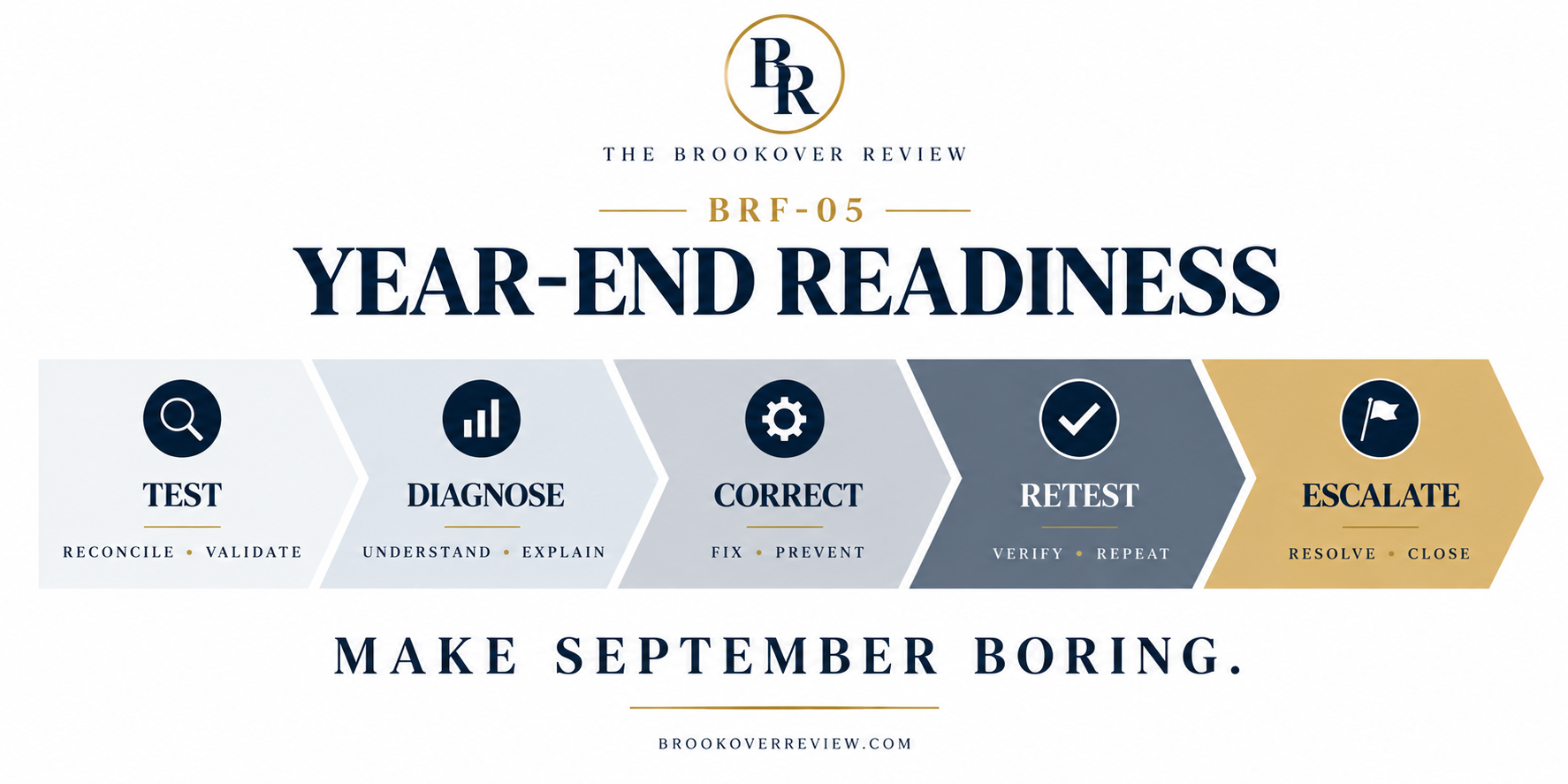
Figure 1. Brookover Review Framework (BRF-05): Year-End Readiness — Test, Diagnose, Correct, Retest, Escalate.
By September, I don't want to be researching old obligations, discovering recurring tie-point failures, finding unexplained topside adjustments, introducing myself to old trading-partner differences, or learning that Accounting and Budget have different expectations for expiring resources.
I want those conversations to have already happened.
I want the problems we could solve to already be solved.
And I want the remaining exceptions to be known, supported, assigned, and actively managed.
That doesn't mean year-end will be easy.
There will always be late activity, unexpected transactions, difficult accounting questions, reporting deadlines, and issues that require judgment.
The objective isn't to eliminate every problem.
It's to avoid spending the most important close of the year solving problems you had eleven other opportunities to find.
Year-end readiness isn't something you establish in September.
It's something you prove throughout the year.
Every month is a test.
Every quarter is a harder test.
Q3 is the dress rehearsal.
September 30 is the final exam.
And if you've prepared correctly, the final exam shouldn't contain any surprises.
The views expressed in this article are those of the author and do not necessarily reflect the views of any employer, client, agency, or organization. Examples referenced are intended to illustrate broader year-end readiness and financial management concepts.
About The Brookover Review
The Brookover Review is an independent publication dedicated to advancing federal financial management through practical insights, original frameworks, and thoughtful discussion. Subscribe to receive monthly bulletins, future articles, and original frameworks covering federal financial management, financial systems, audit readiness, and digital transformation.