
Monthly Bulletin | September 2026
Advancing federal financial management through independent insights, practical frameworks, and meaningful professional dialogue.
From the Editor
September marked another productive month for The Brookover Review, with four articles exploring issues at the center of federal financial management: internal controls, accounting integrity, and year-end readiness.
As the federal government closed FY 2026 and entered FY 2027, these subjects became particularly relevant.
Two articles continued our examination of transaction-processing controls. Another challenged how agencies approach year-end preparation. The fourth continued our technical series on prior-year obligation adjustments.
This month also brought a different way to engage with our work: visual explanations designed to make complex financial management concepts easier to understand, revisit, and share.
Our objective remains straightforward: publish practical analysis that strengthens the federal financial management community.
This Month's Articles
Rob continued his examination of transaction-processing controls with two articles.
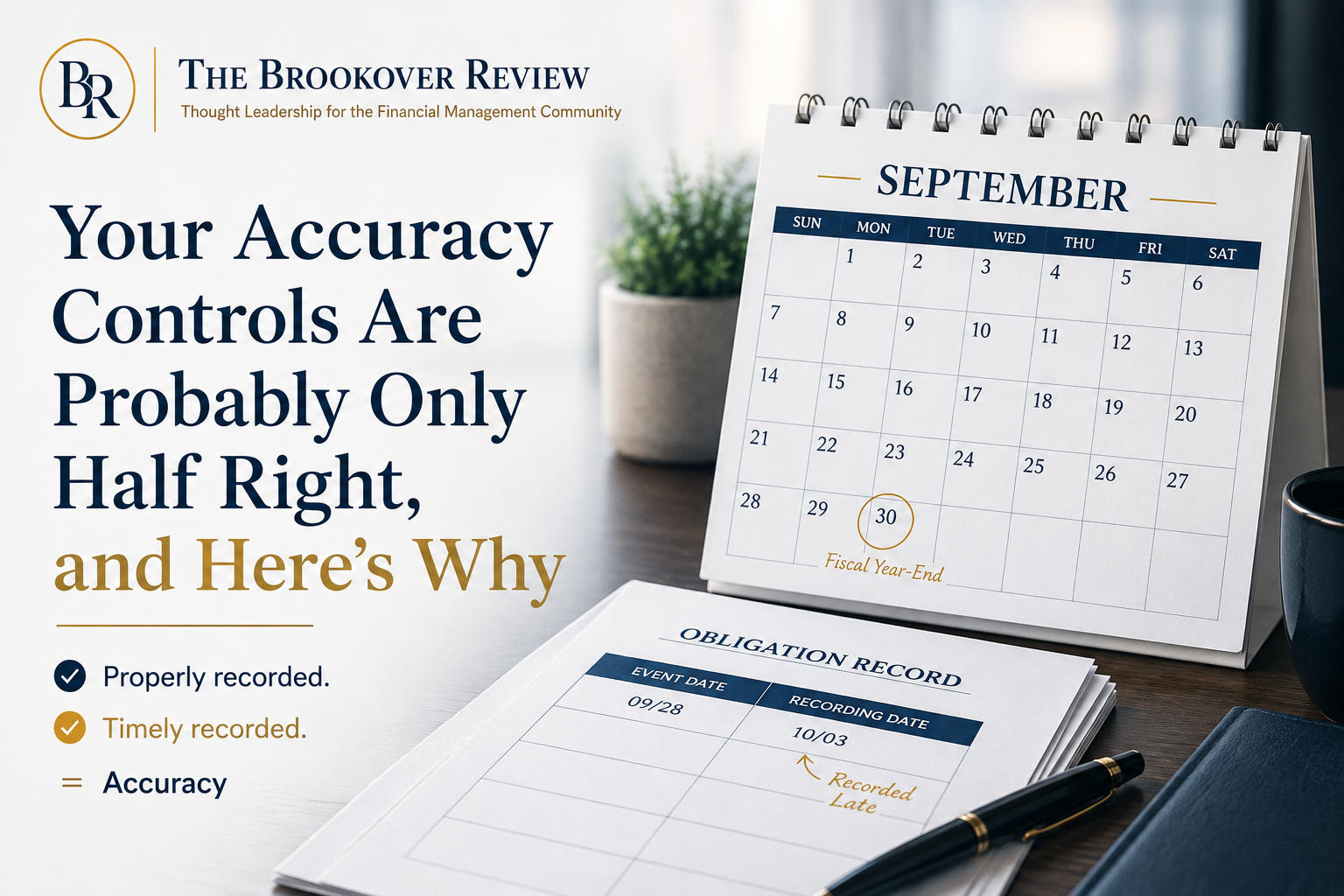
Accuracy is not simply a question of whether a transaction was recorded correctly. Timing matters. A transaction can be accurate in amount and classification but still misrepresent financial activity when recorded in the wrong period.
Read the Article →
System access and transaction authority are related, but they are not interchangeable. Effective controls must consider whether an individual has the authority to act and whether system permissions appropriately enforce that authority.
Read the Article →Together, these articles reinforce a fundamental point: effective internal controls require more than transactions that successfully process through a system.

Year-end should not be the first time an agency discovers whether its processes, reconciliations, and financial information are reliable.
The article introduces a continuous readiness approach built around testing, diagnosing, correcting, retesting, and escalating issues throughout the fiscal year.
The goal is simple: make September boring.
Read the Article →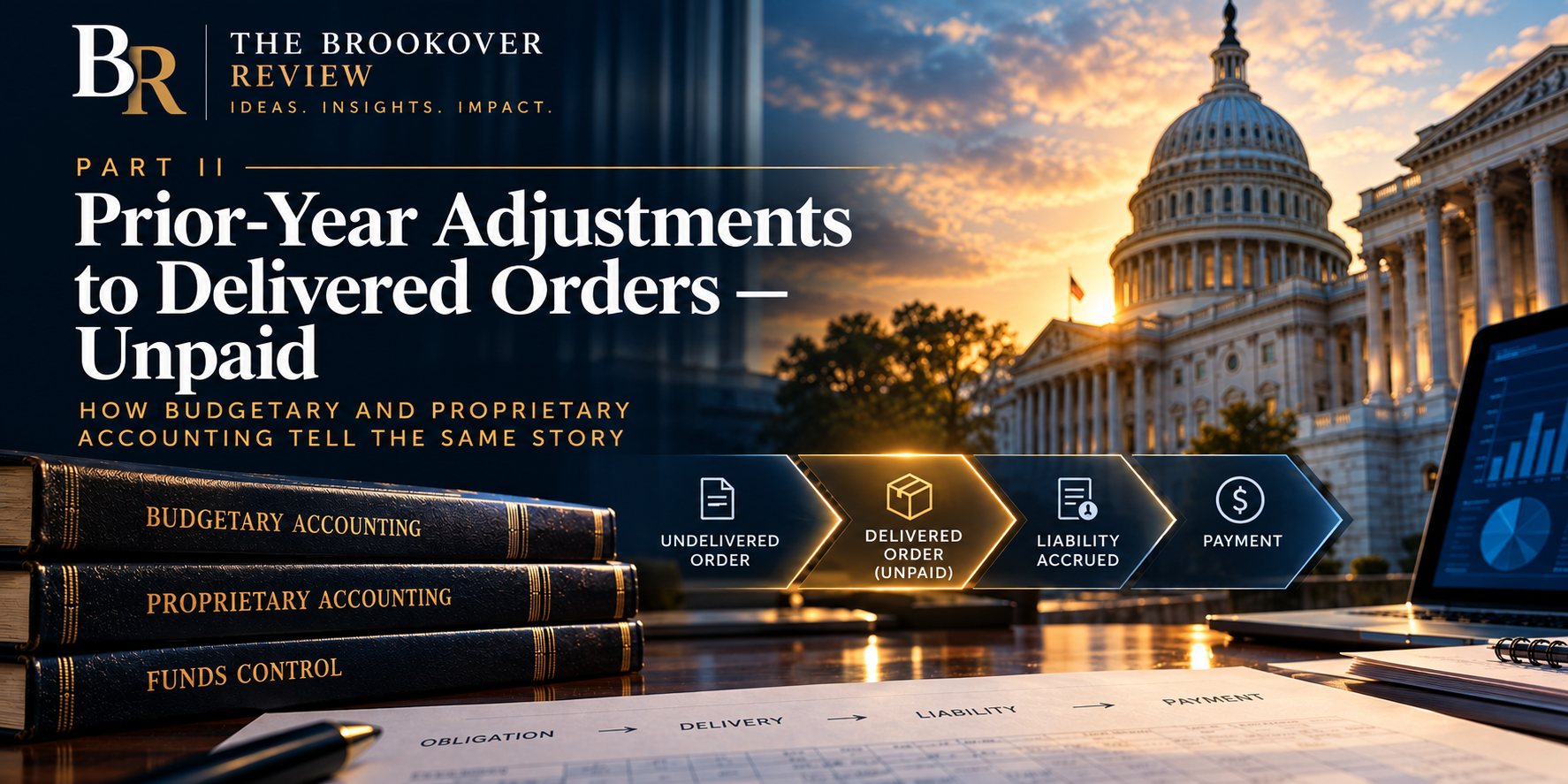
Part II examines prior-year adjustments to delivered orders that remain unpaid, focusing on USSGL accounts 490100, 497100, and 498100.
Through examples involving services and capitalized software, the article demonstrates why adjustments must be understood across both budgetary and proprietary accounting.
The budgetary entry is only half the story.
New This Month
During September, we also expanded how readers can engage with existing Brookover Review analysis through visual explanations of complex financial management concepts.
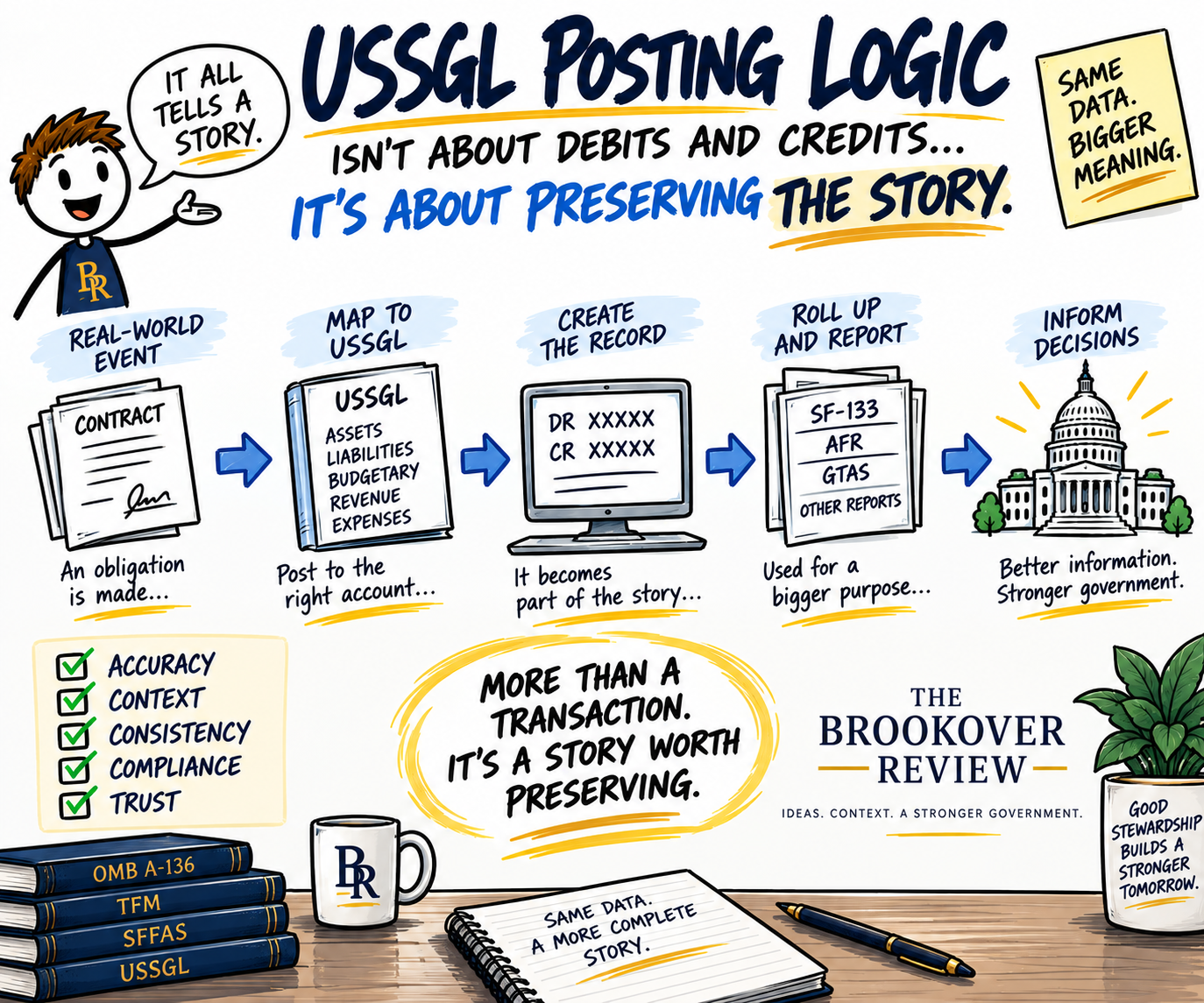
A visual look at how real-world financial events become accounting records, financial reports, and ultimately information used for decision-making.
Read the Original Article →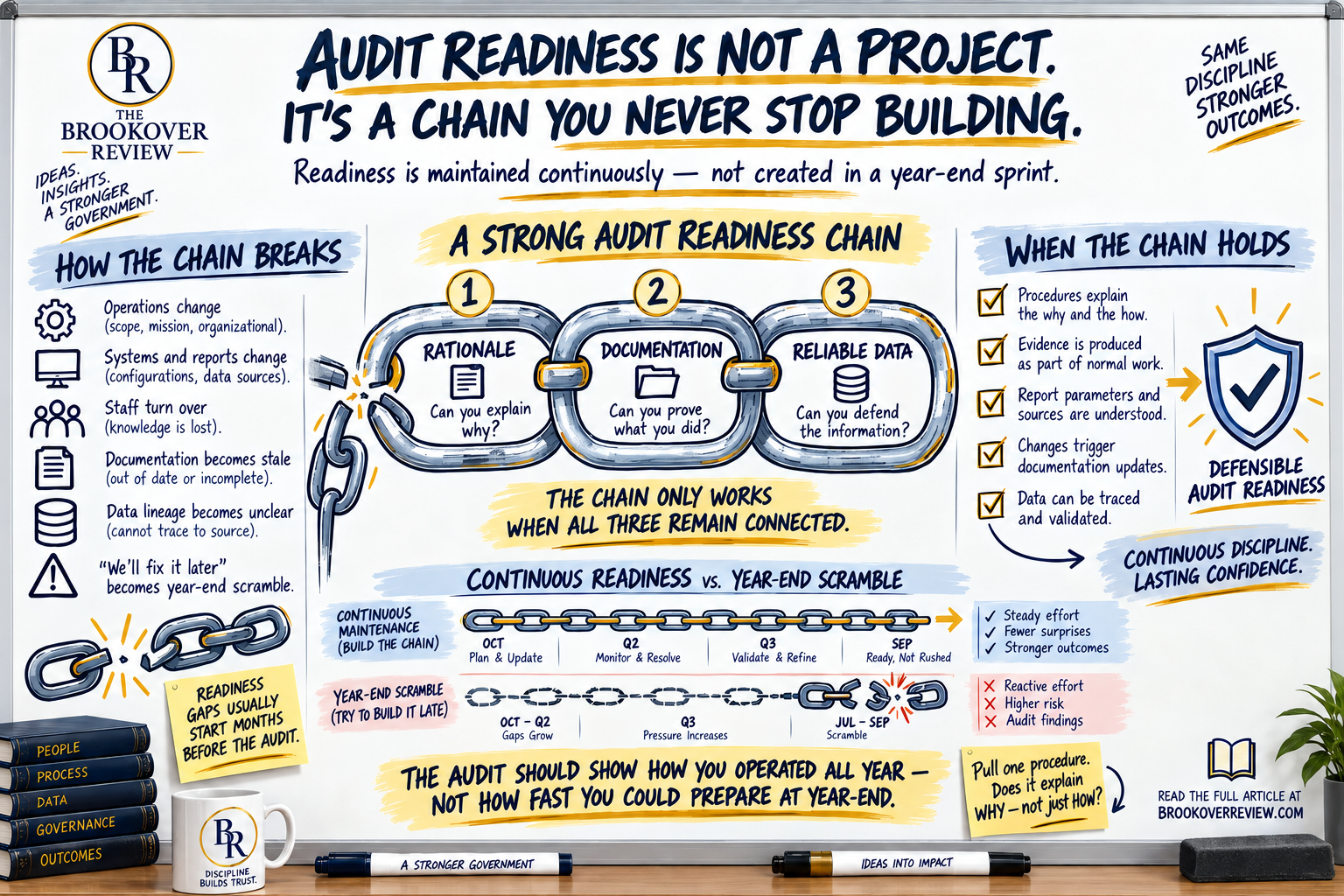
Building on Rob Persons' earlier article, this graphic illustrates the relationship between rationale, documentation, and reliable data — and why audit readiness must be maintained continuously.
Read the Original Article →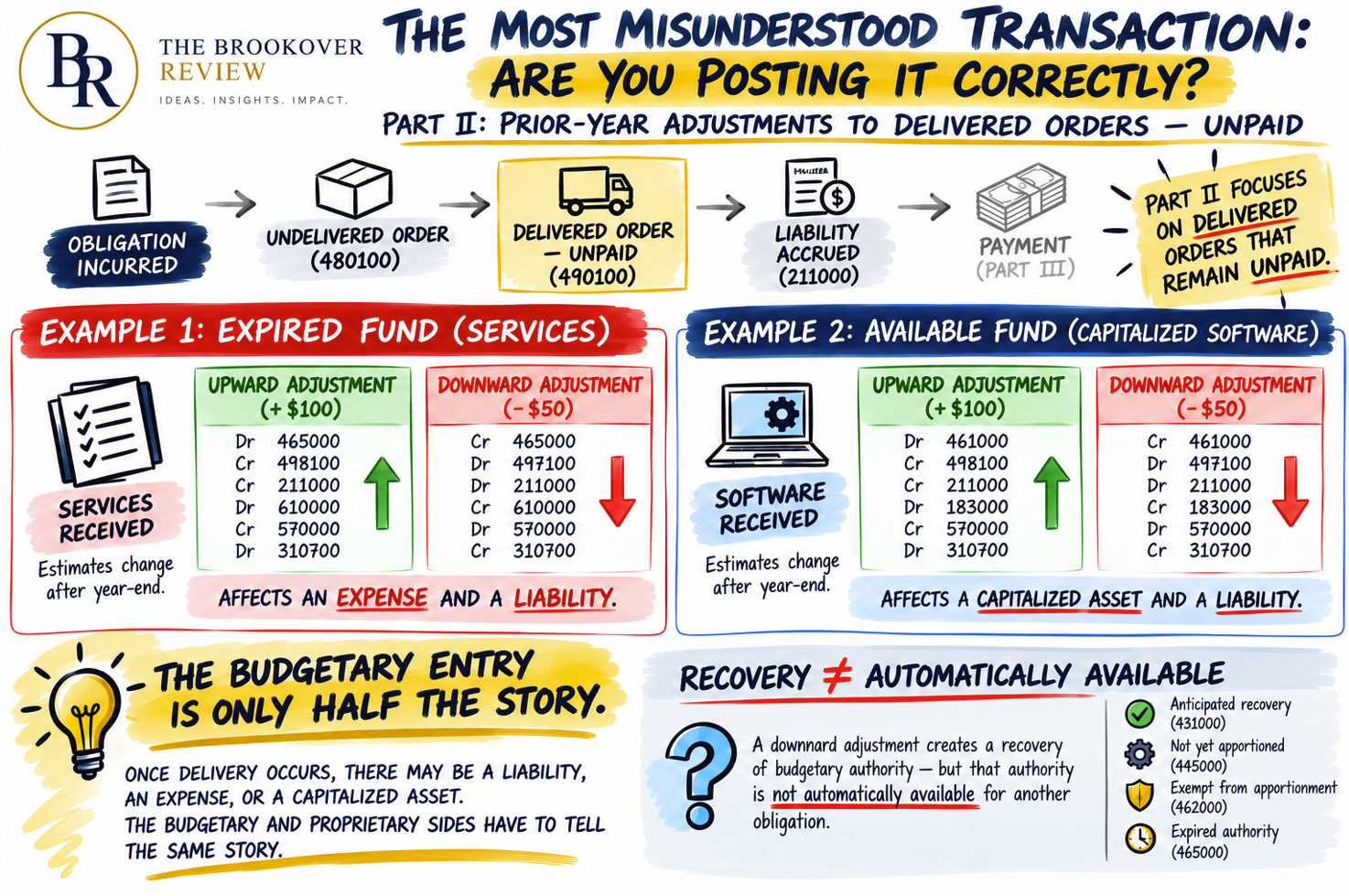
A visual walkthrough of upward and downward adjustments, comparing the accounting implications of services and capitalized software.
Explore Part II →Looking Ahead
A new fiscal year provides an opportunity to evaluate more than the results of the year just completed.
It is an opportunity to strengthen the processes, controls, documentation, and accounting practices that will shape the next one.
As we move into FY 2027, The Brookover Review will continue developing technical analysis, practical frameworks, and visual resources that connect accounting requirements with operational realities.
Thank you to everyone who has read, shared, contributed to, or engaged with our work.
The conversation continues.
Stay Connected
If you have an experience, lesson, or perspective that could help strengthen the profession, we'd welcome the opportunity to hear from you.
Thank you for being part of this growing community. I look forward to continuing the conversation in October.
Stephen W. Brookover, CGFM
Founder & Editor-in-Chief, The Brookover Review